The failure of the Review Conference of the Treaty on the Non-Proliferation of Nuclear Weapons last May underlines how deep international divisions run. As president of the conference, Vietnam championed a diplomacy of listening and balance whose significance goes beyond the immediate outcome of the negotiations.
“My aim was to make everyone equally dissatisfied.” Ambassador Do Hung Viet’s remark sums up an unspectacular reality of diplomacy: a compromise often begins when everyone agrees to give up some of their demands. But states must still judge the agreement preferable to defending their own positions.
That condition was not met at the Eleventh Review Conference of the Parties to the Treaty on the Non-Proliferation of Nuclear Weapons (NPT), held in New York from 27 April to 22 May 2026. After four weeks of negotiations, the delegations parted without a consensus final document. Following the precedents of 2015 and 2022, this third meeting without agreement further weakens states’ ability to define a common response to nuclear risks. United Nations
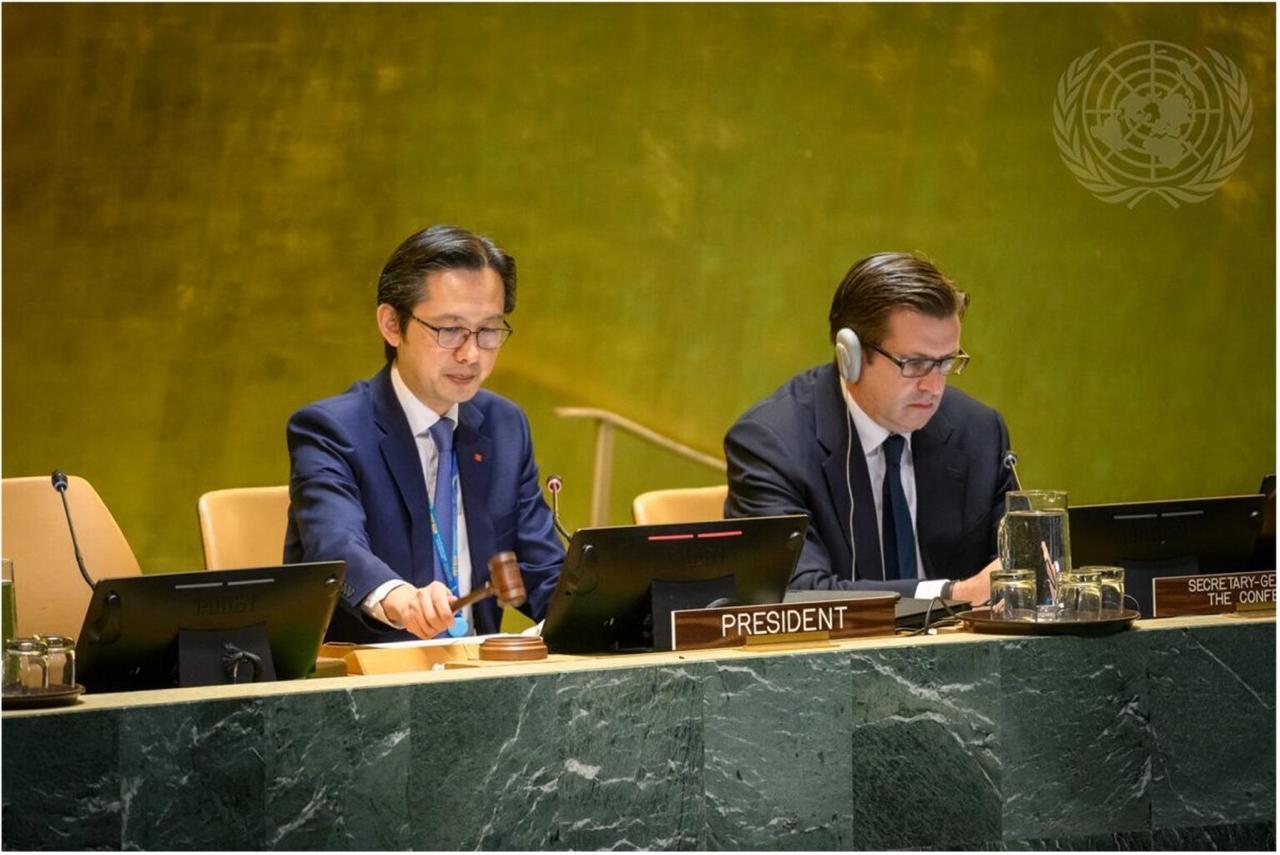
Do Hung Viet (left), President of the Eleventh Review Conference of the Parties to the Treaty on the Non-Proliferation of Nuclear Weapons (NPT) of 2026, chairs the closing session of the conference, which was held from 27 April to 22 May.
For Vietnam, which presided over the proceedings, the outcome nonetheless calls for a more nuanced reading than a mere acknowledgement of failure. The conference also showed what a non-nuclear-weapon state can bring to a negotiation dominated by the security concerns of the major powers: a space for discussion, attentiveness to the expectations of other states and a search for balance between interests that have become hard to reconcile.
A diplomacy attentive to less-heard states
Even before the conference opened, Do Hung Viet had placed listening at the heart of his approach. In an interview with Arms Control Today, he stressed the need to restore dialogue between nuclear powers and non-nuclear states, but also between developed and developing countries. He also noted the difficulties some delegations faced in participating fully in the negotiations and in understanding how compromises were being drawn up. (Arms Control Association)
This question of method goes to the heart of the problem. In multilateral forums, every state has a voice, but not all have the same diplomatic resources or the same capacity to follow several discussions at once. A negotiation perceived as reserved for a handful of players breeds mistrust, even when its conclusions purport to bind all participants.
By seeking to make the process more accessible and transparent, the Vietnamese presidency was thus tackling one of the drivers of the crisis of confidence. The impact of this approach remains hard to gauge, but its value is real: a lasting agreement requires that states can recognise themselves in the process that produces it.
Nuclear compromise goes beyond security issues alone
The NPT rests on a balance between three pillars: non-proliferation, disarmament and the peaceful uses of nuclear energy. The way they fit together forms the political core of the treaty.
States that have renounced nuclear weapons expect their commitments to be matched by progress towards disarmament. They also wish to preserve access to civilian nuclear technologies, in compliance with the treaty’s obligations. When these expectations appear to be relegated behind the concerns of the nuclear powers alone, support for the regime loses some of its political force.
This is where Viet Nam’s positioning takes on its full meaning. By addressing security, responsibility and development together, Hanoi helps to recall that the durability of the NPT depends on the benefit each category of states derives from its implementation. Nuclear medicine, research and agricultural applications give this cooperation concrete expression, beyond strategic negotiations.
This approach offers Viet Nam a useful role: that of an interlocutor able to voice concerns that power relations tend to marginalise.
Mediation in the face of conflict
Listening, however, is not enough to overcome antagonisms that states regard as essential to their security. According to the account in Arms Control Today, differences between Washington and Tehran over the wording on Iran’s nuclear programme were a major obstacle to a final compromise. Other disagreements also remained. (Arms Control Association)
In an interview published after the conference, Do Hung Viet explained that he had considered several scenarios before deciding against submitting a text whose foreseeable rejection would, in his view, have deepened the divisions. His account sheds light on the difficulty of his position: preserving the impartiality of the presidency while trying to secure a political outcome. It also reflects the negotiator’s own assessment of his actions and should be read as such. (en.baoquocte.vn)
The lack of agreement remains a setback. It nonetheless highlights the fundamental limit of any multilateral presidency: it can bring wording closer together, organise discussions and propose reciprocal concessions. The decision to accept them rests with the states.
After the conference, keeping standards high
Viet Nam’s statement to the First Committee of the General Assembly on 8 October continued this approach. In it, Do Hung Viet called for the NPT review process to be strengthened and for shared commitments to be implemented. He also urged nuclear-weapon States to step up dialogue, reduce risks and make substantial progress on arms control and disarmament. (en.nhandan.vn)
Continuity matters. Presiding over a conference can remain a fleeting moment of diplomatic visibility. It takes on greater significance when the country that held the presidency goes on championing the negotiation’s objectives after it has closed.
For International Geneva, this experience is also a reminder of the value of the work carried on between the major gatherings: keeping lines of communication open, clarifying disagreements and preparing proposals that could become negotiable. Such efforts attract less attention than a final declaration, but they help preserve the conditions for a future agreement.
Viet Nam’s positive role lies in this perseverance. Hanoi has not overcome the rifts in the international nuclear order. It has sought to contain them within a common framework for discussion, while stressing that the responsibilities of the nuclear powers must meet the expectations of other States. At a time of weakened multilateralism, this ability to keep a negotiation open is a diplomatic contribution that deserves recognition — and whose value will also depend on the concrete follow-up it receives.
Translated from French. The French original prevails.