By Professor El Hassane HZAINE
The Middle East has a long history of failed collective defence pacts , as Florence Gaub points out. The Arab League has intervened in only a quarter of inter-Arab conflicts, with a success rate of 20%. Only three crises in the League’s history have led to collective security action : the civil war in Yemen (1962-1967), where intervention came only after Egypt had voluntarily decided to withdraw its troops; the intervention against Iraqi threats to Kuwait in 1961; and the 1990 crisis, when Saddam Hussein ordered the invasion of Kuwait.
All three cases show that Arab collective security works only when normative consensus aligns with the interests of the most powerful states. Like the setbacks of Arab economic integration, this ineffectiveness is largely explained by sovereigntism, ideological divergences and power rivalries, compounded by the requirement for unanimity/consensus that governs decision-making in the Arab League and the OIC. Any member state can veto any action, rendering the organisation virtually powerless in the face of the inter-coalition conflicts that dominate Arab politics.
Compounding this institutional deadlock is a jealous protection of national sovereignty, with Arab chiefs of staff having always been reluctant to place their troops under foreign command, while there is also no consensus on how to define the threat. It is against this backdrop of repeated failures – from the Unified Arab Command of 1964 to the aborted proposal for an “Arab NATO” in 2025 – that the Mecca Accord bursts onto the scene, raising the central question of whether it will succeed in overcoming the mistakes of the past and establishing a new paradigm of collective security. On Friday 7 August 2026, in Mecca, Saudi Crown Prince Mohammed bin Salman, Turkish President Recep Tayyip Erdoğan and Pakistani Prime Minister Shehbaz Sharif signed the Mecca Joint Defence Accord. Inspired by NATO, the trilateral pact stipulates that an armed attack against any one of the three states will be considered an attack against them all.
The symbolism of the occasion was carefully orchestrated: a signing on a Friday in the cradle of Islam, presented as an act of religious and civilisational solidarity as much as a conventional treaty of alliance. Beyond this symbolic dimension, however, lies a more measured strategic calculation, born in a region that has been shaken by several shocks in recent years : the Arab Spring, civil wars in Syria and Yemen, the tragedy of Gaza and the tripartite war of Hormuz.
The agreement could therefore revolutionise collective security in the Middle East. It is not a treaty in the Western sense of the term, with an integrated command structure, a common budget or a joint headquarters; it is first and foremost a political commitment, described by its signatories as “purely defensive”, in keeping with the right of self-defence under Article 51 of the Charter of the United Nations.
Background: a region in upheaval
The agreement cannot be analysed in isolation from the conflict that has shaken the Gulf since 28 February 2026, when the United States and Israel carried out strikes on Iran that killed Iran’s Supreme Leader. Tehran’s retaliation extended well beyond Israel, hitting infrastructure in Saudi Arabia, Kuwait, Bahrain, Qatar, the United Arab Emirates, Oman and Jordan.
At the same time, Iran’s closure of the Strait of Hormuz, followed by the US naval blockade of Iran, cut shipments of crude oil and liquefied natural gas by around 90%, a disruption of such magnitude that Gulf officials do not expect flows to recover fully before 2027 and are studying scenarios for bypassing the Strait of Hormuz. Riyadh, in particular, was directly exposed and targeted despite its normalisation of relations with Iran following mediation by Beijing.
This sustained exposure, which occurred despite decades of US security guarantees and billions of dollars in arms purchases, appears to have done more to catalyse the Mecca pact than any other single event. The pact follows on from, and builds on, a bilateral defence agreement between Pakistan and Saudi Arabia signed in Riyadh in September 2025, itself prompted by earlier shocks, notably the Iranian and Israeli strikes on Doha that had alarmed Gulf capitals.
The trilateral agreement is therefore the logical continuation of a gradual process through which the Gulf states sought to insure themselves against any failure of Washington’s protection.
The logic of the pact: complementarity and operational challenges
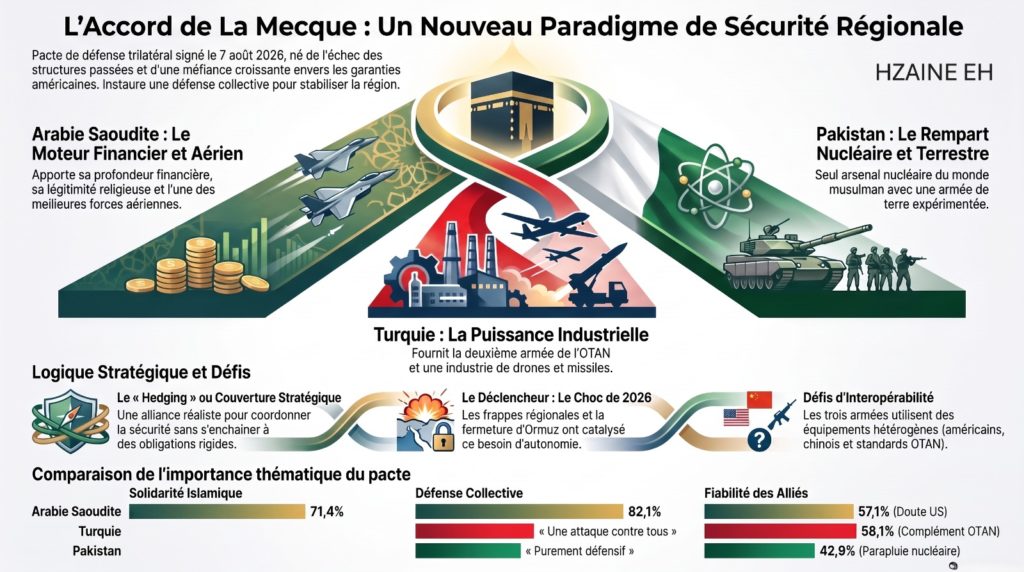
The agreement rests on an obvious complementarity ; Turkey brings NATO’s second-largest army and a defence industrial base that has become a significant producer of drones and missiles ; Saudi Arabia offers its financial depth, notably to guarantee the financial security of its allies with international institutions, as well as religious and institutional legitimacy as the seat of the OIC and the GCC, and it also has one of the best-equipped air forces in the region ; as for Pakistan, it is home to the only nuclear arsenal in the Muslim world, as well as a large army long accustomed to training and advising Gulf armed forces.
However, complementary assets are not synonymous with integrated command ; as several defence experts have pointed out, the three armed forces operate with different equipment: American systems predominate in Saudi Arabia, a mix of Chinese and domestic platforms exists in Pakistan, and Turkey uses NATO standards as well as domestic systems. But diversification does not mean an absence of opportunities for interoperability, particularly for the navies and air forces.
Decoding the signatories’ narratives
A content analysis of 87 official documents, statements and speeches by the three countries between 7 and 17 August 2026 reveals distinct but overlapping narrative strategies.
- Saudi Arabia is putting forward a defensive narrative of strategic hedging. A defensive tone appears in 82.1% of documents, and Islamic solidarity in 71.4%. The emphasis on doubts about the reliability of external guarantees (57.1%) predominates. The Saudi Deputy Minister for Public Diplomacy, Dr Rayed Krimly, made clear that the pact was “not a military axis or a sectarian bloc, nor linked to nuclear ambitions”, adding that its fundamental aim is to develop lasting defensive capabilities, strengthening collective deterrence and ensuring a coordinated response to any threat against any of the three signatories.
- Turkey has adopted an institutional and complementary narrative; complementarity with NATO is mentioned in 58.1% of documents. Ankara is reassuring its allies that the pact is not a competitor, while using it to assert itself as an autonomous regional power. Turkish state media have relayed the maxim “an attack on one will be considered an attack on all”.
- Pakistan, for its part, is centring its discourse on institutionalisation and mediation. The nuclear umbrella appears in 42.9% of Pakistani documents. The Ministry of Foreign Affairs is reassuring its neighbours by disputing rumours that the pact would extend a “nuclear umbrella” to the Gulf country, while the Deputy Prime Minister, Ishaq Dar, insisted that the agreement was “purely defensive” and “not directed against any country”.
Observers describe the pact’s aim as building deterrence to counterbalance Iranian, Israeli and even Indian influence, rather than seeking direct confrontation.
International reactions: between silence and strategic restraint
The Mecca Agreement has drawn mixed reactions from the main regional and international powers, reflecting their divergent strategic interests and their respective perceptions of this new security realignment.
– Iran has adopted a strategy of rhetorical neutralisation, oscillating between disdain and calculated concern. Media close to the government such as “Kayhan” and “IRNA” have welcomed any defence agreement between Muslim nations as a natural response to regional instability, while taking care to warn that it must not serve a foreign agenda. This dual stance reflects Tehran’s desire to play down the scope of the pact while showing heightened vigilance towards any attempt at encirclement.
– Israel has adopted a stance of discreet vigilance, expressed through media close to the government such as “Israel Hayom” and “The Jerusalem Post”. Israel’s main concern reportedly lies in the potential emergence of an autonomous regional “third bloc” distant from both the Iranian axis and the US-Israeli alliance. The concern is warranted given the strength of this bloc, which combines economic power, a defence industry and a nuclear arsenal ; three ingredients capable of redrawing the configuration of the Middle East, at a time when Turkey’s increased role is perceived as a growing strategic threat.
– For its part, India has shown a cautious attitude, closely examining the pact’s implications for the strategic balance in South Asia. New Delhi’s main concern lies in the participation of Pakistan, which now enjoys increased diplomatic and military support from two influential powers.
– Egypt has adopted a position of calculated pragmatism, welcoming any initiative that strengthens Islamic collective security. Its Minister of Foreign Affairs, Badr Abdelatty, made clear that Cairo was not a member of the alliance for the time being, for technical and constitutional reasons requiring “in-depth studies” before any accession, in accordance with the Egyptian constitution and its legal obligations. This position reflects Egypt’s strategic caution and its determination to maintain a foreign policy balanced between the various regional powers, avoiding commitment to a military alliance that could compromise its room for manoeuvre.
– The United States saw the agreement as the institutionalisation of long-standing cooperation, regarding it as an adjustment rather than a move away from Washington. President Donald Trump welcomed the pact on “Truth Social”, calling it a “great, bold and important first step” and seeing it as proof that “West Asia is coming together” and that the countries are “capable of defending themselves more effectively”. This stance of calculated acceptance reflects Washington’s wish to see its Gulf allies diversify their security options while maintaining strong bilateral ties, at a time when the United States has struggled to persuade its NATO allies to back it in the war effort.
– For China, described as the “silent winner” by Indian commentators, the agreement is a realignment that confirms its vision of a multipolar world; Beijing welcomes the diversification of security arrangements in the Middle East, which reduce exclusive dependence on the United States and weaken its central role in the region. Nevertheless, Beijing is said to face a dilemma: should the agreement turn into an anti-Iranian pact, it could threaten China’s strategic relationship with Tehran, its key oil supplier, and complicate its diplomatic balancing act with the Gulf states.
Characterising the Pact in the light of theories of alliances and collective security
Behind the unprecedented rapprochement between Riyadh, Ankara and Islamabad lie dynamics that historians of international relations and theorists of military alliances know well.
Stephen Walt, in his seminal work The Origins of Alliances (1987), reminds us of an all too often forgotten truth: states do not ally against a power, but against the threats they perceive. It is precisely this lens that sheds light on the convergence of the three capitals, alarmed by a regional environment in full decay.
Yet the prerequisites for the success of such an undertaking are exacting; Zacher warns us that without a shared perception of the threat, without genuine interoperability of forces and without an integrated command, alliances are often little more than pious hopes. That is not the case with this pact, whose outlines are beginning to emerge and which point to the establishment of joint committees, joint military exercises and manoeuvres, and the integration of defence industries.
Pollmann, for his part, lists the historical obstacles – asymmetry of capabilities, the risk of entrapment, diplomatic provocation, loss of autonomy – all hurdles that the Mecca Accord is struggling to overcome. Some authors point out that the success of security arrangements is often correlated with the existence of a coordinator, a core area, a driving force, just as in economic integration ; the Kingdom of Saudi Arabia is ideally placed to act as the catalyst in this pact.
For Jean-Bertrand Ribat, an alliance is not enough on its own to defeat a hegemon; it needs a catalyst/coordinator with the financial resources to support its allies, a strategic vision shared by its elites, and the diplomatic skill to maintain cohesion. It is this capacity to supply additional power, combined with the art of negotiation, that turns a mere coalition into an effective instrument of crisis management. Without this pillar, alliances will be doomed to failure.
The Mecca pact is neither an Islamic NATO nor a new CENTO
Interpreting the scant data available suggests that this pact is a pragmatic, realist alliance rather than an ideological one – a Sunni axis against a Shia axis, or an alliance of conservatives against revisionist radicals ; the three countries are not pursuing the idealistic military integration some had hoped for. They are practising what the literature on small and middle powers calls hedging – a form of strategic insurance – which allows them to coordinate their security policies without shackling themselves to rigid obligations. Survival, in short, rather than total commitment. A lesson in realism that alliance theorists have never tired of repeating.
– Comparisons with NATO are inevitable given the language used. The Turkish Minister of Foreign Affairs, Hakan Fidan, said the pact was “technically analogous to NATO’s Article 5 in terms of collective defence”.
However, observers note major structural differences. Professor Serhat Güvenç, of Kadir Has University, points out that, unlike NATO, this pact is intended to be an “alliance of equals”. “This has its advantages and its drawbacks,” he explains, “because decisions will be taken through negotiation and states will, in many respects, prioritise their national sovereignty.” Alison Minor, of the Atlantic Council, adds that “given the sometimes divergent interests of the three countries, this alliance is unlikely to provide a fully integrated military response to various crises, as NATO does.”
– Moreover, although in some respects it recalls the Baghdad Pact of the 1950s – which brought together Turkey, Pakistan and Iran under Western auspices – the Mecca Accord differs radically from it in its nature and objectives. Whereas CENTO was an instrument of containment devised in Washington to build a bulwark against Soviet expansion, the 2026 pact is a home-grown alliance, forged by and for its three members in response to the erosion of the unipolar order and the loss of confidence in American security guarantees. It is an alliance between regional powers whose motives are rooted in a quest for strategic autonomy and risk management far more than in a logic of ideological confrontation or containment.
Towards a diversification of security guarantees
The Mecca Accord stems from a shared determination by three states, endowed with complementary strengths and a common sense of vulnerability, to pool their deterrence rather than confront the hegemons alone or remain hostage to a single external guarantor. It institutionalises long-standing cooperation and is designed to improve regional interoperability without necessarily constituting a response aimed at any specific actor. The future of the Mecca Accord will depend on how its members manage several structural variables.
To assess the operational viability of this pact, it is essential to draw on the lessons of Marc Zacher’s empirical work on regional collective security systems. Zacher showed that the success of such architectures rests on strict conditions.
First, the need for a convergent perception of the threat. Yet the Mecca Accord brings together three states whose security priorities remain fundamentally divergent (India for Pakistan; Iran and the Houthis for Saudi Arabia; Greece, the Kurdish question and turbulent relations with Israel for Turkey). Without a clearly identified common threat, triggering the collective defence clause risks running up against minimalist interpretations.
Second, complementary assets do not automatically translate into an integrated command. At this stage, there are no shared data links, no status of forces agreements, no prepositioned stockpiles and no joint headquarters. As Zacher points out, it took NATO roughly a decade to build such an infrastructure.
Third, Zacher highlights the cost of sovereignty. States are reluctant to cede control of their armed forces to a regional entity. Moreover, regional collective security systems often fail unless they enjoy the benevolent tolerance of a hegemonic power.
Several questions therefore remain open and will serve as tests of the agreement’s durability :
- Technical development: will the pact evolve into an integrated defence system on the Arabian Peninsula, or will it remain primarily a political signal (hedging) and a framework for industrial cooperation?
- Institutionalisation : will the Pact become an independent international organisation, or will it be attached to the OIC by means of a protocol ?
- Enlargement: will the agreement be open to accession by other OIC member states, such as Egypt, the UAE, Indonesia, Morocco or Qatar, and how would such expansion affect decision-making dynamics?
- Reconciling divergent priorities: the three states do not share identical threat perceptions ; the pact’s success will depend on the agreement’s ability to manage these priorities without becoming ineffective.
Ultimately, the Mecca Agreement represents less a break with the past than a pragmatic and promising evolution in regional security cooperation. By capitalising on genuine complementarity – Turkey’s defence industry, Saudi Arabia’s financial and air power, and Pakistan’s military expertise – the pact lays the foundations for a collective deterrent aimed at stability rather than confrontation.
While operational integration remains a task for the future, the agreement sends a strong signal of geopolitical maturity: that of three regional powers choosing to pool their strengths to safeguard their security and the regional balance. Far from being a mere strategic hedge, it marks the beginnings of a multipolar regional order, capable of turning shared vulnerabilities into common resilience in the face of the uncertainties of an international system in transition.
References
- Ahmed, A.Y. Inter-Arab Conflicts 1945-1981: An Exploratory Study.
- Ahmed Ali Salem. Collective Security in the Arab League: Between Realist and Constructivist Theories.
- Ali Eddin Hilal. The Arab Regional System: A Study of Arab Political Relations.
- Gaub, F. (2016). An Arab NATO in the Making? Middle Eastern Military Cooperation Since 2011. Carlisle: Strategic Studies Institute and U.S. Army War College Press.
- Hzaine, E.H. (2026). ‘Le système régional arabe : un ordre bloqué en état de stagnation’. Afrimag, 2 March.
- Ribat, J-B. (2012). ‘Opening the Balance of Power Theory’s Black Box, Do We Need a Coordinator?’, in Yeager, M.P. & Carter, C. (eds), Pacts and Alliances in History. London: I.B. Tauris.
- Samaan, J-L. (2023). New Military Strategies in the Gulf: The Mirage of Autonomy in Saudi Arabia, the UAE and Qatar. London: I.B. Tauris.
- Snyder, G.H. (1997). Alliance Politics. Ithaca: Cornell University Press.
- Walt, S.M. (1987). The Origins of Alliances. Ithaca: Cornell University Press.
- Yeager, M.P. & Carter, C. (eds) (2012). Pacts and Alliances in History: Diplomatic Strategy and the Politics of Coalitions. London: I.B. Tauris
Translated from French. The French original prevails.