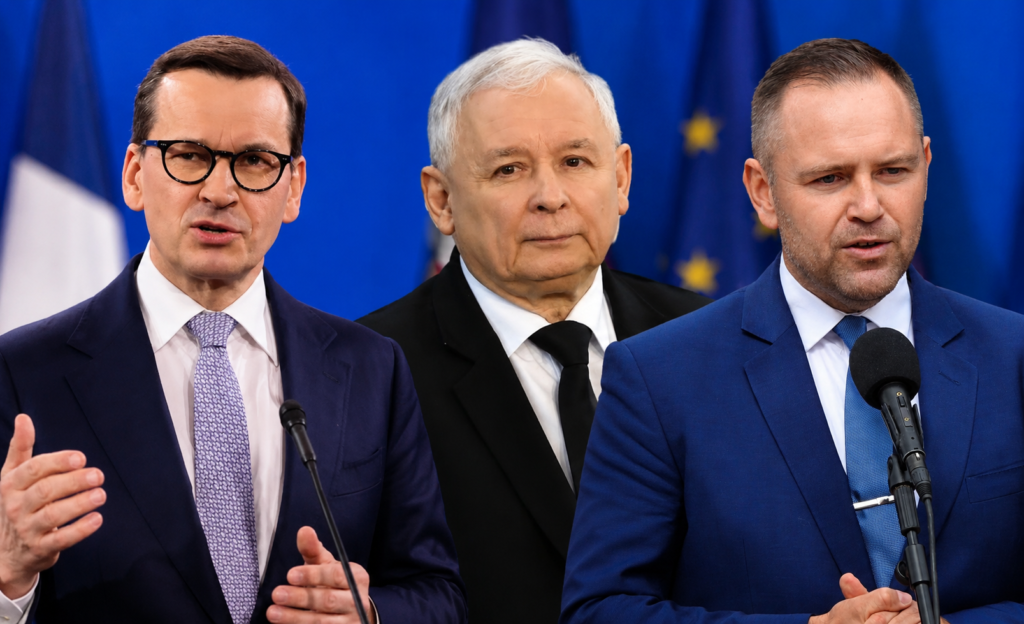
From left to right: Mateusz Morawiecki, Jarosław Kaczyński and Karol Nawrocki. Created with AI.
For almost two decades, Polish politics was shaped by the rivalry between two camps: Donald Tusk’s Civic Platform and Jarosław Kaczyński’s Law and Justice (PiS). Tusk built Poland’s main centrist, liberal force. Kaczyński made PiS the main conservative force.
In July 2026, an internal conflict within PiS turned into an open political split. The former Prime Minister Mateusz Morawiecki is launching the “Rozwój Plus” movement, which has been joined by some 40 MPs and one senator. It is not yet a new party, but the break is now complete.
For the first time in many years, the right is no longer organised around an undisputed leader. Alongside PiS, other political groupings are now emerging that target the same conservative electorate. The question is therefore no longer simply whether PiS will manage to return to power, but whether PiS will remain the main home of Polish conservatives after the Jarosław Kaczyński era.
“Law and Justice” was founded in 2001 and, over a quarter of a century, has become one of the most influential political forces in contemporary Poland. The party was called upon to form a government on two occasions, after the 2005 and 2015 elections. Following its 2015 victory, PiS remained in power until 2023.
What makes Kaczyński unusual is that his political influence has never depended on holding an official post. He was not Prime Minister for most of the years in which PiS was in power, yet he remained the party’s chief strategist, the man who set its political course and arbitrated the balance between the various factions of the conservative camp.
Kaczyński still leads PiS. But the question of succession no longer belongs to the distant future. He is 77. The question is therefore no longer simply when his political career will end, but whether a party built around his authority will be able to hold together. The July conflict showed precisely how difficult that transition could be.
Kaczyński is seeking to preserve internal discipline within PiS. Morawiecki, for his part, set up his own political vehicle, “Rozwój Plus”, in April 2026, and has begun attracting officials willing to consider a different path for the conservative right. What began as a dispute over party discipline has thus turned into a struggle over who embodies the Polish right.
The split is a done deal. But its final shape has yet to be determined
At first, the “Rozwój Plus” movement presented itself as a platform for expertise. It gradually became an autonomous centre of influence. In July, the PiS leadership asked its members to give up any involvement in other political organisations. Morawiecki refused, and a sizeable group of some 40 MPs followed him.
On 29 July, a distinct parliamentary bloc thus formed around “Rozwój Plus”. It now carries enough weight that it can no longer be described as a mere internal faction of PiS, but rather as an independent political force in Parliament. Care should nevertheless be taken not to present this process as complete. “Rozwój Plus” is not yet a genuine new party. Some of the MPs who sided with Morawiecki are still subject to disciplinary proceedings within PiS, while the final shape of the new political project remains open. It is therefore more accurate to speak of a political split that has already taken place, but whose organisational expression is still under way.
For the first time in a long while, a party is in a position to lay claim to part of the PiS electorate. And that changes the very logic of the contest. Until recently, the question was who would succeed Kaczyński at the head of PiS. Now it is gradually becoming: is any single party capable of inheriting the role of representing the conservative camp as a whole?
The electoral geography of PiS
PiS has never been the party of all of Poland. Its strongholds have traditionally been in the east and south-east of the country, in small towns and rural areas, among voters more attached to Catholic and conservative values. By contrast, the big cities – Warsaw, Gdańsk, Poznań, Wrocław – have long been markedly more favourable to liberal and pro-European forces. This geography helps explain one of PiS’s main problems. The party has a particularly loyal core electorate. But that same core is also its electoral ceiling.
PiS does not need to win back its traditional electorate. Its problem lies elsewhere: to regain the ability to govern alone, mobilising its base is not enough. It must win over voters beyond its own camp. It is precisely here that the strategic difference between Kaczyński and Morawiecki emerges. Kaczyński is betting above all on preserving PiS’s political identity and on the loyalty of its historical electorate. Morawiecki advocates a different approach: he wants to broaden the right beyond its traditional base. Meanwhile, to the right of PiS, other forces are emerging and are also seeking to capture part of this electorate.
Morawiecki: Kaczyński’s successor or founder of a new right?
Mateusz Morawiecki was long regarded as one of the main contenders to succeed Kaczyński. His career differs from that of many of PiS’s long-standing figures. Before rising to prominence, he worked in the financial sector and ran Bank Zachodni WBK. In 2015 he joined the PiS government, and in 2017 he became Prime Minister. This path helped build his image as a more technocratic, more economically minded and more pragmatic politician. That very identity could become his main asset after the split.
Morawiecki must now win over right-wing voters on matters of the state, security and national interests. His challenge is not simply to bring over some of PiS’s MPs. He must turn the organisational split into an independent political brand and show that there is an electorate that supports a right-wing government without wanting a return to the old PiS model.
The public activity of “Rozwój Plus” shows that broadening its electoral base is one of the project’s central objectives. That is why Morawiecki is seeking to present himself not only as an alternative to Kaczyński, but also as the possible starting point for a broader conservative coalition. The new project nonetheless faces a major difficulty: for now, it is far stronger organisationally than electorally.
According to a United Surveys poll conducted for Wirtualna Polska at the end of July, a hypothetical “Rozwój Plus” list would win around 7.5% of voting intentions. Another survey gave Morawiecki’s project 7.4%. That is already enough to envisage parliamentary representation, but not enough to speak of a new centre of gravity on the Polish right. (Rzeczpospolita)
A distinction must also be drawn between support for the new project and assessments of its future prospects. When a poll shows that a significant share of Poles consider Morawiecki’s project capable of clearing the threshold for entry to the Sejm, that does not mean this level of support reflects its actual electoral strength.
Two “Confederations”: two different threats to PiS
PiS must also contend with the fact that there are already not one but at least two significant political forces to its right. The first is Konfederacja, associated chiefly with Sławomir Mentzen and Krzysztof Bosak. This right-wing force champions, among other things, strong economic liberalism, limited state intervention and a more critical stance towards some European Union policies.
The second is Konfederacja Korony Polskiej, or the Confederation of the Polish Crown, led by Grzegorz Braun. It is an antisemitic nationalist force, more radical on the European Union and on relations with Ukraine. The latest polls show the scale of this competition. According to IBRiS data for “Rzeczpospolita”, at the end of July PiS stood at 17.3%, Konfederacja at 12.3% and Konfederacja Korony Polskiej at 10.9%.
The situation is therefore profoundly different. PiS no longer faces a single rival force. To its right there now stretches a whole range of political projects. The conservative camp may have considerable combined electoral potential. But that does not automatically mean that these votes can be turned into a parliamentary majority.
Four right-wing projects may together attract a significant share of the electorate and, at the same time, prove incapable of forming a government because they compete with one another. That is where PiS’s real problem lies. It is not merely a matter of losing voters, but of losing the ability to turn the right’s combined electoral potential into a parliamentary majority.
If PiS moves to the right to stop its voters defecting to more radical forces, it risks losing moderate conservatives. If it moves back towards the centre, it leaves more room for Konfederacja and the Confederation of the Polish Crown. And if part of the moderate conservative electorate joins Morawiecki, PiS risks losing ground on its right and in the centre at the same time.
Nawrocki: a third pole of power
Another figure could yet upend this entire configuration: Karol Nawrocki. In 2025, the PiS-backed candidate defeated Rafał Trzaskowski in the second round of the presidential election, with 50.89% of the vote to 49.11%. The result showed that Poland’s conservative camp could muster a majority in a presidential election.
Yet Nawrocki is not simply an extension of Kaczyński. He now has an asset of his own: his presidential mandate. The Polish right therefore potentially has several centres of gravity: the PiS party machine, Morawiecki’s political project and Nawrocki’s presidential pole.
Nawrocki may remain an ally of PiS. But he could also gradually become the arbiter of a broader conservative camp. In that case, the question of Kaczyński’s succession would take on an entirely different dimension. It would be embodied not in the emergence of a leader but in a right-wing coalition, in which the party leader would no longer hold a monopoly over the conservative electorate.
Ukraine as a test for the new right
The “Ukrainian question” has also become an important indicator of the internal realignment of the Polish right. The issues of grain, aid to Ukrainian refugees, historical memory, military support for Ukraine and its possible future accession to the EU are increasingly tied to a broader question: what does the national interest really mean for Polish conservatives?
For some on the right, a firmer stance towards Ukraine shows that the Polish state defends first and foremost the interests of its own voters. For others, an excessive focus on disputes with Ukraine could weaken Poland’s strategic position in the region and its role on NATO’s eastern flank.
It is precisely here that the Ukrainian question exposes a deeper ideological rift. For part of the Polish right, the national interest increasingly means greater autonomy from Brussels, a firmer defence of the country’s economic and historical interests and a more cautious stance towards Ukraine. For another part of the conservative camp, by contrast, Poland’s strength rests on its role within NATO, the EU and, more broadly, the Western security system. The Ukrainian question is therefore more a symptom than a cause of the crisis.
What the Polish press says: one crisis, several readings
The Polish media’s reactions to the conflict running through PiS show that this is no longer merely a battle within the party. Depending on the newsroom, the split brings different risks for the future of Polish politics to the surface. “Rzeczpospolita” sees the conflict above all as the start of a sweeping realignment of the right. Its political columnist Michał Szułdrzyński described the rupture as the beginning of a transformation the Polish right had not experienced in years. What is at stake is not only winning over voters, but building future coalitions to determine who will be able to form a government after the next parliamentary elections. (Rzeczpospolita)
“Gazeta Wyborcza”: Morawiecki is building an alternative
Gazeta Wyborcza takes a markedly more critical stance towards PiS and Morawiecki. Its articles stress that “Rozwój Plus” has gradually evolved from an internal initiative into an autonomous political centre. The newspaper is closely following the MPs who have chosen to stay with Morawiecki, as well as his efforts to form his own parliamentary group. (wyborcza.pl)
For Gazeta Wyborcza, this is above all a power struggle within the right and an attempt by Morawiecki to exploit the PiS crisis to build his own project.
Onet: can Morawiecki turn the split into electoral support?
Onet focuses more on a concrete question: can Morawiecki’s new structure become a genuine electoral force? Following the split, Onet points out that “Rozwój Plus” already has a sizeable group of parliamentarians, but that its support in the polls remains, for now, far below that of the main political parties. (onet.pl) In other words, Morawiecki’s organisational success does not yet guarantee electoral success.
Do Rzeczy: a dangerous split for the entire right
Do Rzeczy, a right-wing conservative publication, analyses the situation from a different angle. Its articles place greater emphasis on the risk that the split will weaken not only PiS but the right as a whole. The publication points out that Morawiecki is not necessarily seeking to attack Kaczyński directly, but that the creation of an autonomous centre objectively increases competition between the various conservative forces. (Do Rzeczy).
From the standpoint of the conservative right-wing press, the question is not simply who will emerge victorious from the Kaczyński-Morawiecki duel, but whether the right-wing vote will be so scattered that no conservative force will be able to form a government. Despite their political differences, the Polish media ultimately converge on one point: this is no longer merely an internal conflict within PiS. “Rzeczpospolita” sees the beginning of a realignment of the right. “Gazeta Wyborcza” sees Morawiecki’s alternative project taking shape. Onet sees a test of his electoral potential. “Do Rzeczy” sees a risk that the right as a whole will be weakened by a splintering of the vote.
Four scenarios for the future of the Polish right
Given the current configuration of the Polish right, four scenarios can be envisaged for what comes next.
- First scenario: fragmentation becomes the new norm
The simplest scenario is one in which the current rift is not overcome. PiS would remain one of the main conservative parties, but would no longer have a monopoly on the right. Alongside it would sit “Rozwój Plus”, Konfederacja and the Confederation of the Polish Crown. In such a configuration, the main problem would be the splintering of the right-wing vote across several parties. This could weaken the right as a whole at parliamentary elections, even if combined support for conservative forces remained high.
- Second scenario: Morawiecki turns the rift into a new party
“Rozwój Plus” could gradually become a fully fledged political project. Morawiecki would then seek to bring together part of PiS’s traditional electorate, moderate conservatives, entrepreneurs and voters who want a right-wing government without a return to the extreme polarisation of the previous decade.
This would be the most direct challenge yet to Kaczyński. But Morawiecki cannot simply be “the anti-Kaczyński”. He must offer voters a positive political model: an economic policy, a clear position on the EU, a vision of the state, a policy towards Ukraine and an answer to the question of social benefits. Without fresh political substance, the project risks remaining no more than a parliamentary breakaway from PiS.
- Scenario three: the right reunites
The opposite scenario cannot be ruled out. After a period of rivalry, PiS and Morawiecki’s circle could once again look for a common formula. The reason could be very simple: parliamentary arithmetic. If the fragmentation of the right-wing electorate jeopardised the return of conservative forces to power, some leading figures might conclude that the conflict needs to be frozen or brought to an end.
In that case, Kaczyński could lose some of his control over the party, but PiS would retain its role as the right’s main organisational platform. The party would thus avoid definitive disintegration, but it would be difficult to return to the old model of undisputed leadership.
- Scenario four: Nawrocki becomes the new centre
Perhaps the most interesting scenario is one in which the main outcome of the PiS crisis would not be a stronger Morawiecki, but a gradual shift of the right’s centre of gravity towards the president. Nawrocki has something that none of the internal contenders to succeed Kaczyński has: a national mandate of his own, won directly from the voters.
If he manages to preserve his influence over PiS, maintain working relationships with the other forces on the right and build his own political network, he could become not Kaczyński’s successor, but the figure around whom part of the Polish right seeks to rebuild itself.
The succession question would then change in nature. It would no longer be a matter of who takes Kaczyński’s seat, but of who is capable of coordinating Poland’s various right-wing camps.
What this means for Tusk
The paradox is that Donald Tusk could be one of the main beneficiaries of the PiS crisis – at least in the short term. If the conservative electorate splits between PiS, Morawiecki, Konfederacja and the Confederation of the Polish Crown, it will become harder for the right to turn its combined support into a parliamentary majority. Several Polish and international observers are already making this point.
The Financial Times described the PiS split as a possible political “lifeline” for Tusk’s government in the run-up to the 2027 parliamentary elections: conservative votes could now be divided among four camps. But that does not mean Tusk will automatically win the game.
If Morawiecki manages to build a broad centre-right force and Nawrocki becomes its symbolic centre, the Polish right might not weaken but, on the contrary, broaden its electoral base. Tusk would then no longer be up against Kaczyński’s old PiS, but against a new system of competing conservative forces capable of reaching agreements among themselves after the elections.
For Tusk, then, the most favourable scenario is not simply the fall of PiS. What would benefit him most would be a lasting confrontation between the various forces on the right, preventing them from turning their combined electoral support into a joint parliamentary majority.
Poland after Kaczyński
For two decades, PiS was the conservative right, and PiS was the Kaczyński brothers. That can no longer be taken for granted. Jaroslaw Kaczyński is trying to preserve the party and its identity. Morawiecki has already created his own political vehicle. Konfederacja is putting pressure on PiS from the right. The Confederation of the Polish Crown occupies an even more radical segment. And President Karol Nawrocki has his own political mandate and the potential to lead the conservative camp.
Kaczyński still controls PiS. But he no longer necessarily controls the right-wing camp as a whole. Morawiecki may not become his successor. Nawrocki may not take over the leadership of PiS. Konfederacja may not ally itself with any of these forces.
If the current fragmentation becomes entrenched, the Kaczyński era could end not with the arrival of a new undisputed leader, but with the disappearance of the model itself — one in which a single party and a single man defined the contours of the Polish right.
Translated from French. The French original prevails.