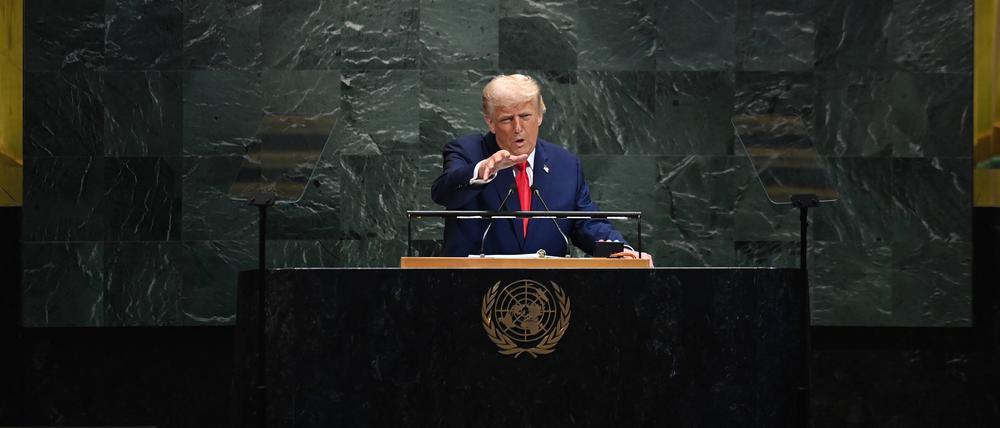
Donald Trump at the rostrum during the United Nations General Assembly in New York, where he attacked the ICC.
Donald Trump announced from the rostrum of the United Nations on 22 September, during the UN General Assembly, that Washington would impose on the International Criminal Court, based in The Hague, sanctions unprecedented against an institution, on a par with those targeting terrorists and those who harbour them. Marco Rubio, the US Secretary of State, had warned that Washington would dismantle the international judicial institution “brick by brick, if necessary”. Were this threat to be carried out, the Court, as a legal entity, would be barred from access to the banking and financial system (closely tied to the dollar), to insurance and to American technologies (the ICC has, moreover, turned to a German company for its IT system, hitherto run by the American firm Microsoft).
This type of sanction already affects the daily lives of 13 of the Court’s 18 judges in The Hague, including the ICC’s Japanese President, Tomoko Akane, who was targeted last August, as well as the Senegalese Deputy Prosecutor, Abdoulaye Seye. ” The unacceptable new sanctions imposed by the United States on the President of the International Criminal Court and a member of the Office of the Prosecutor must be lifted “, the Geneva-based UN Human Rights Office had demanded on the social network X. The President, for her part, warned “of the risk of the international rule of law disappearing “. With the ICC in crisis and its Prosecutor, Karim Kahn, removed following an “inappropriate relationship with his assistant”, this escalation of the arsenal deployed against the ICC clearly puts it in danger.
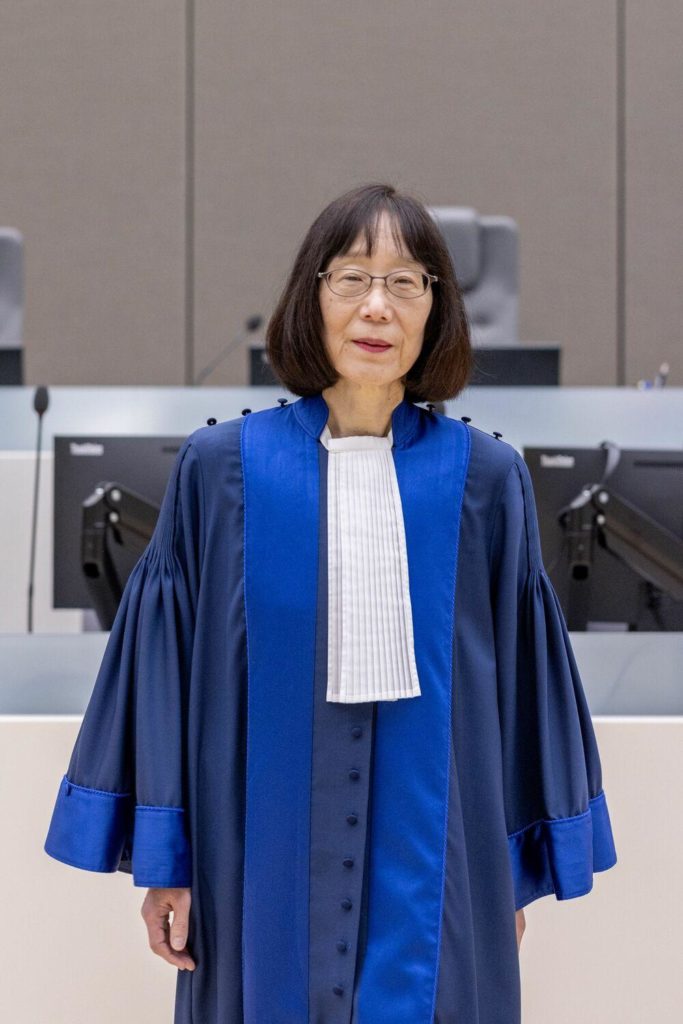
The President of the International Criminal Court, Tomoko Akane, has in turn been hit with a series of sanctions by the Trump administration.
Its demise would be another major setback for the international conflict-prevention system, as the indictment of leaders of powerful states, such as Russia or Israel, sets precedents that may give other potential warmongers pause for thought. All countries committed to the multilateral system have denounced US interference in the affairs of international justice.
Four American non-governmental organisations have filed a lawsuit against the Trump administration, arguing that the sanctions violate the First Amendment to the Constitution, which guarantees freedom of expression. The Netherlands, where the Court is based, has for its part asked the European Union to adopt “a blocking statute” to shield the institution from these sanctions.
The United States, which has not ratified the Rome Statute, signed in 1998, which gave rise to the ICC in 2002, has never accepted that a court of foreign judges could prosecute Americans. “It would be difficult for most of us to imagine a world in which American soldiers, police officers, Border Patrol agents and elected officials could be dragged before an international tribunal, tried by judges drawn from random countries around the world, convicted under international laws to which we do not consent and which we do not control, and then imprisoned thousands of kilometres from America,” a State Department statement said.
Washington’s offensive began in 2020, after the International Criminal Court opened an investigation into “war crimes committed by members of the United States armed forces” in Afghanistan, ruling that the proceedings brought against them by the United States government were insufficient in the Court’s view.
On top of this came the ICC’s arrest warrants against the Israeli Prime Minister, Benjamin Netanyahu, and the former Defence Minister, Yoav Gallant, for war crimes and crimes against humanity linked to starvation during the conflict in Gaza, in May. On his way to the UN General Assembly in New York, the Israeli head of government, despite being subject to an arrest warrant, passed through several of the 125 signatory countries to the Rome Statute without being troubled. At the same time, Prosecutor Khan had charged Hamas’s leader in Gaza, Yahya Sinwar, the head of Hamas’s military wing, the Al-Qassam Brigades, Mohammed Deif, and the movement’s political leader, Ismail Haniyeh, with “war crimes”.
Washington is putting pressure on its allies, and on countries that depend heavily on it, to withdraw from the ICC. Venezuela, under the new leaders installed by Trump, withdrew in July. The Chavista regime had previously denounced the “neo-imperialist” policies of the Court, which potentially threatened President Maduro with prosecution for numerous human rights violations. Mali, too, has followed the American injunction.
But the United States is not alone in urging states to withdraw as signatories to the Rome Statute. After Vladimir Putin was indicted for a “war crime” over the deportation of Ukrainian children abducted and transferred to Russia, the Kremlin did not need to ask three Sahel states with close ties to Moscow to withdraw. Mali, Burkina Faso and Niger did so last June.
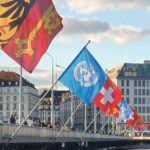
Switzerland, committed to defending international justice, notably helped to draft an amendment to the Rome Statute defining “the crime of aggression”, a new crime subject to international prosecution that could apply to the invasion of Ukraine, for example. Bern has put forward a candidate for the election in December of a new judge in The Hague: Guénaël Mettraux, from the canton of Vaud, who has 25 years of experience in international law. If elected, he too could face the sanctions that have hit the sitting judges. And Bern will have to stand firm, no doubt coming under pressure from Washington in its turn.
Translated from French. The French original prevails.