The proliferation of outposts and settler violence is gradually turning the West Bank into a military problem for Israel itself. In Qusra, the army had to protect Palestinian families from Israeli settlers. The head of Central Command, Avi Bluth, is now warning that a single “spark” could set the territory ablaze and divert more of the IDF’s resources. Adding to these tensions are the weakening of the Palestinian Authority and the continued presence of armed networks in the northern West Bank.
Qusra, symptom of a shift
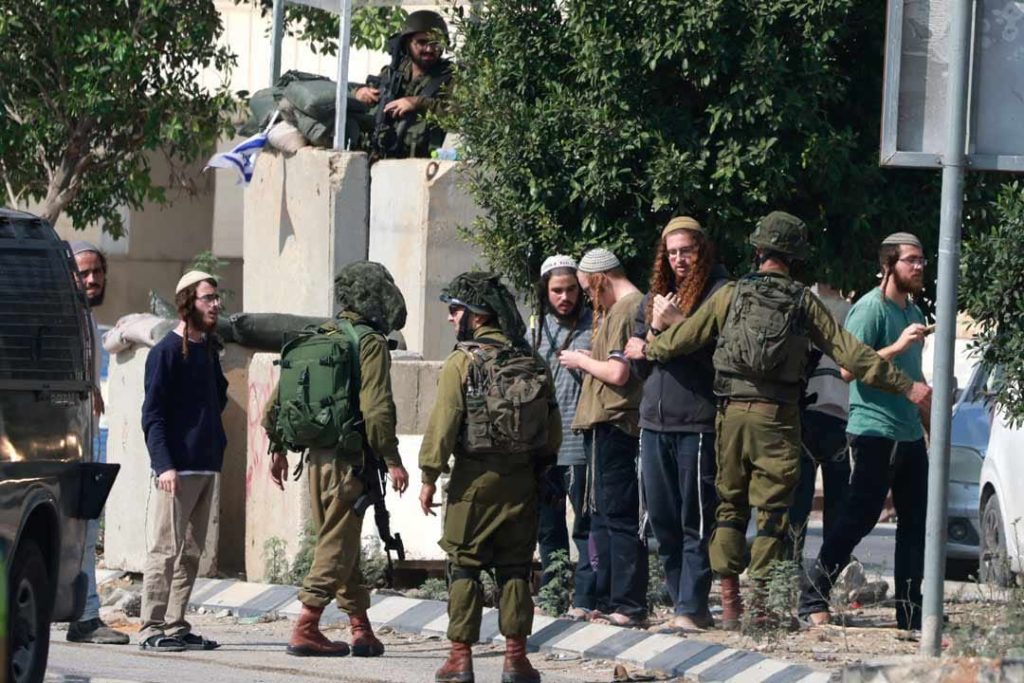
It all began with an unusual scene. On 12 August, in Qusra, south of Nablus, Israeli soldiers attempted to dismantle an outpost set up by settlers right up against Palestinian homes. The settlers resisted. Clashes broke out with the army, which used riot-control measures before withdrawing without fully resolving the situation. Reuters described this rare confrontation as one of the most visible signs of the growing tension between the IDF’s security imperatives and the activism of part of the settlement movement.
The episode did not end there. Settlers had surrounded several homes, cut off water and electricity and set up structures right next to the houses. The Israeli army eventually deployed dozens of soldiers to the area. On 20 August the US ambassador to Israel, Mike Huckabee, despite being a long-standing supporter of the settlement movement, publicly condemned attempts to seize properties belonging, among others, to Palestinian Americans.
The significance of Qusra lies less in its size than in what it reveals: each additional outpost can create a new flashpoint that the army must monitor, protect and, at times, contain. As these flashpoints multiply, the geography of settlement increases the military burden.
The “hilltop youth”: a movement without a single command structure
The term “outpost” here refers to a settlement established without formal authorisation from the Israeli government. These sites are therefore illegal under Israeli law until they are regularised; all West Bank settlements are, moreover, considered illegal under international law by the UN and most states. According to Peace Now data cited by Human Rights Watch, 65 new outposts were established between the start of 2026 and 1 August, and 248 since the current coalition took office. Another Peace Now count recorded, at the end of April, 363 outposts established since 1996; this is a historical cumulative total, as some have since been evacuated or regularised.
The best-known movement is the “Hilltop Youth” – No’ar HaGva’ot. It is not a centralised organisation with a leadership, membership cards and published numbers, but a decentralised network of young religious nationalist activists based around outposts and pastoral farms. There is therefore no reliable figure for its size. Around this milieu revolve more organised structures that provide material support, funding or political backing. The Hilltop Foundation, for example, circulated a map this summer claiming sixteen outposts between Ramallah and Nablus.
Far right lends support
Itamar Ben-Gvir is not the leader of this movement, but he gives it political and ideological support. Ben-Gvir, who emerged from Kahanism, now belongs to the national-religious current of Israeli Zionism and leads the Otzma Yehudit (Jewish Power) party. As Minister of National Security, he oversees the police, among other things. The government figure with the most direct institutional leverage over the expansion and regularisation of settlements, however, remains Bezalel Smotrich, Minister of Finance and leader of the Religious Zionism party. He also wields significant civilian powers in the West Bank within the Ministry of Defence.
The blurring of the line between militant activism and national politics has nonetheless become hard to ignore. On 25 August, Zvi Sukkot, a Knesset member from the Religious Zionism party, travelled under military escort to the Palestinian village of Madama, south of Nablus, where he and those accompanying him smashed a memorial to “martyrs” with a hammer. According to Israel Hayom, as cited by The Times of Israel, the monument honoured several Palestinians who had been killed, among them Yaman Tayeb Ali Faraj, a senior figure in the Popular Front for the Liberation of Palestine (PFLP) described by Israeli sources as having been involved in the 2003 Geha Junction suicide bombing, which killed four people and injured more than twenty, and Shadi Nasser, who carried out a suicide bombing in Ariel in 2002 that injured fourteen people.
The Israel Defense Forces confirmed that soldiers had been diverted from their operational duties to protect the MK and accused him of acting in a “deceptive and manipulative” manner. Benjamin Netanyahu’s office subsequently described the conduct as “unacceptable”, stressing that such an initiative diverted the army from its duties. The incident illustrates, almost in real time, the problem described by military officials: civilian or political initiatives create additional incidents that the army must then deal with.
The warning now comes from the Israeli military command
On 24 August, at a closed-door security meeting with Benjamin Netanyahu, General Avi Bluth, head of Central Command and Israel’s most senior military officer in the West Bank, issued his clearest warning yet. According to The Times of Israel, citing Channel 12, Bluth explained that Palestinian attacks had fallen sharply over the past two years, but that there was now a “match” capable of setting the West Bank ablaze: “nationalist crime”, a term used here to refer to violence committed by nationalist settlers.
His second message is even more strategic: the IDF’s attention is constantly being diverted to these incidents instead of being devoted to preventing Palestinian attacks. In other words, the military command no longer describes settler violence merely as a public order problem. It now sees it as a drain on the army’s operational resources.
The Chief of Staff, Eyal Zamir, also warned Netanyahu of the risk of an “explosion” in the West Bank. The Prime Minister reportedly asked him what plan the army would put into action if the territory went up in flames. On the same day, the army announced that elements of the 35th Paratroopers Brigade would be redeployed to the West Bank after three months of operations in the Gaza Strip.
The distinction matters: the paratroopers had been deployed in Gaza since June, under the 143rd and 99th Divisions, notably along the “Yellow Line”, the demarcation line in Gaza separating areas under Israeli control from Palestinian sectors. Over those three months, they destroyed or sealed some 13 kilometres of tunnels and set up defensive positions. Their redeployment to the West Bank does not, in itself, mean that a new intifada is imminent. It does show, however, that this theatre once again requires combat units fresh from an already gruelling campaign.
Violence shifts its geography
The other shift is territorial. A study by the Israeli organisation Yesh Din, published on 21 August and reported by The Guardian, shows that settler violence is moving into Areas A and B, in other words into the areas where most of everyday Palestinian life is concentrated.
This division stems from the 1995 Oslo II Accord. Area A, around 18% of the West Bank, comprises the main Palestinian cities and was meant to fall under Palestinian civil administration and internal security. Area B, around 22%, is under Palestinian civil administration; security responsibilities there are shared, with Israel retaining the predominant role for external security. Area C, around 60% of the territory, remains under Israeli civil and security control. This arrangement was meant to be temporary; more than thirty years later, it still shapes the reality on the ground.
According to Yesh Din, 55% of the incidents of settler violence recorded in 2026 reportedly took place in Area B, compared with 25% in 2025. Area C’s share, by contrast, is said to have fallen from 67% to 37%. The organisation also notes the emergence of outposts in the corridor between Ramallah and Nablus. These figures come from a human rights organisation and must be presented as such, but the trend they describe is consistent with the observations of the United Nations.
In its humanitarian report of 14 August, the United Nations Office for the Coordination of Humanitarian Affairs – OCHA – recorded 38 incidents involving settlers that resulted in Palestinian casualties or property damage, sometimes both, during the period covered. In Tuba, in the south of Hebron, five Palestinians had been injured and three residential structures set on fire. In Qusra, a barrier installed on 9 August had cut off several households and limited their access to water and food.
The human toll must be read before the economic one. As of 10 August, the United Nations counted 76 Palestinians killed in the West Bank since the start of 2026, including 18 children, by Israeli forces or settlers. The following weeks were again marked by deaths, injuries and displacement. The proliferation of incidents therefore does not merely produce an abstract tension: it constantly widens the number of places where military, police or medical intervention may become necessary.
The problem can no longer be reduced to a series of scattered clashes. It is tending to form a network of flashpoints: Nablus, Qusra, Jalud, Ramallah, Hebron, Masafer Yatta. Each point may remain local. Taken together, however, they end up weighing on the military deployment.
On 25 August, a fresh incident in Jannatah, south of Bethlehem, illustrated this pattern. Settlers attacked Israeli activists who had come to support Palestinian residents, as well as a team of three journalists from AFP; at least five people were injured and the agency’s vehicles were damaged. The IDF declared the area a “closed military zone” and a police investigation was opened. Here again, clashes around an outpost forced the security forces to intervene, adding Bethlehem to the map of flashpoints.
An economic time bomb beneath the security crisis
This territorial pressure is compounded by deep economic fragility. On 11 August, the UN judged that the West Bank was at a “breaking point”. The warning focused in particular on the financial crisis facing the Palestinian Authority, made directly worse by Israel’s withholding of the tax revenues it collects on the Authority’s behalf. The financial mechanism is worth spelling out. Under the 1994 Paris Protocol, Israel collects, on behalf of the Palestinian Authority, a large share of the VAT, customs duties and other taxes on goods entering the Palestinian territories, which it must then transfer to it. According to the Palestinian finance minister, Estephan Salameh, these “clearance revenues” account for around 68% of the ministry’s revenue. In June 2026, the Palestinian government put the cumulative total of sums withheld or deducted by Israel at $5.7 billion. The emergency budget for 2026 states that, if these transfers remain blocked, the deficit could reach almost 70% of the budget.
Arab states continue to support Ramallah, but on a scale out of all proportion to this shortfall. Saudi Arabia announced $90 million in financial support for 2025 and helped launch an emergency coalition aimed at keeping the Palestinian Authority solvent. The World Bank also identified Algeria as the leading Arab donor of direct budget support in the first half of 2024, with $51.9 million. In July 2026, Mahmoud Abbas was still calling on the Arab League to activate its “financial safety net”. The problem, then, is not a total absence of Arab aid, but its limited and irregular nature when set against tax revenues that run into billions. Donors can provide one-off cash-flow support; they cannot permanently replace the Palestinian Authority’s main source of revenue.
Public-sector salaries, health services and Ramallah’s administrative capacity are under growing pressure. A Palestinian Authority unable to pay its employees regularly or to maintain its services inevitably sees its capacity for control and its legitimacy erode. Restrictions on movement make matters worse still by limiting access to work, markets and services.
Political vacuum fuels armed groups
The fragility of the Palestinian Authority is also opening up space for armed structures that fall outside its security apparatus. In the northern West Bank, particularly around Jenin and Tulkarm, local “battalions” bring together or coordinate militants from Palestinian Islamic Jihad, Hamas and, depending on the town, the Al-Aqsa Martyrs’ Brigades. Islamic Jihad played an important role in the emergence of the “Jenin Battalion” model, while Hamas retains clandestine networks and the capacity to recruit.
It would, however, be an overstatement to present this rise of armed groups as proof that they are on the verge of winning elections in the West Bank. Islamic Jihad is not an electoral player comparable to Fatah or Hamas. As for the cells claiming allegiance to the Islamic State group (Daesh), they remain politically marginal compared with the networks of Hamas, Islamic Jihad and local groups.
The latest poll by the Palestinian Center for Policy and Survey Research, published on 12 August, paints a more complex picture. According to the PCPSR, Hamas has lost significant ground in the West Bank: 18% of respondents now say they support the movement, compared with 32% ten months earlier. Among likely voters in the legislative elections announced for November 2026, 34% would choose Fatah, 25% Hamas, and 32% remain undecided. In the event of a presidential election, Marwan Barghouti holds an overwhelming lead among likely voters in the West Bank. A leading Fatah figure, he has been imprisoned by Israel since 2002 and was sentenced in 2004 to five life terms; he is often described as a possible successor to Mahmoud Abbas.
The political danger, then, is less an inevitable Hamas victory than a fragmentation of Palestinian legitimacy. In the same poll, 82% of respondents in the West Bank want Mahmoud Abbas to step down, 87% say they are worried about the risk of losing their land or homes as a result of settlement expansion, and 65% of all Palestinians regard the Palestinian Authority more as a burden than as an asset. A society can thus turn away from its leaders without rallying behind any single movement.
This is where the security risk becomes circular. Economic and political deterioration fuels resentment; outposts multiply violent encounters; armed networks find fertile ground for recruitment; violence prompts the deployment of more Israeli forces; and that military presence in turn creates fresh opportunities for confrontation.
The risk is not military defeat but overstretch
Israel retains overwhelming military superiority in the West Bank. The danger, therefore, is not a conventional defeat but gradual overstretch: the army must deploy ever more soldiers to protect roads, settlements, outposts and threatened Palestinian communities, carry out arrest operations and man checkpoints, while keeping forces available for the other fronts. This is what gives Avi Bluth’s warning its significance. A series of local outbreaks of violence can remain militarily manageable. But if their number rises far enough, quantity becomes a strategic variable. The army must then devote a growing share of its resources not to defeating an adversary, but to preventing dozens of flashpoints from merging.
The West Bank could thus become a front of a particular kind: not a theatre in which Israel is threatened by an equivalent military force, but a space where the combination of settlement, violence, Palestinian economic and political weakening, the presence of armed groups and geographical dispersal ends up curtailing its freedom of action. The predicted explosion has not yet happened. But the situation remains dangerous. The security set-up is still holding, but with more soldiers, more points of friction and less margin. In the West Bank, the steady deterioration is no longer merely political or humanitarian. It is beginning to become an operational problem for Israel itself.
Read more in La Tribune des Nations
• West Bank: UN condemns tightening of Israeli control – 12 February 2026
Sources
• Reuters, 12 August 2026 – Qusra: clashes between Israeli soldiers and settlers
• Human Rights Watch, 20 August 2026 – outposts and settler violence
• The Jerusalem Post, 24 August 2026 – Avi Bluth’s warning and the redeployment of paratroopers
• The Guardian, 21 August 2026 – violence shifting to Areas A and B
• OCHA, 14 August 2026 – humanitarian situation in the West Bank
• UN, 11 August 2026 – “The West Bank is at the breaking point”
• PCPSR, 12 August 2026 – Poll No. 97 on elections and Palestinian public opinion
• Reuters, 8 October 2025 – profile of Marwan Barghouti and leading Palestinian figures held by Israel
• Palestinian government, 8 June 2026 – clearance revenues: 68% of revenue and $5.7 billion withheld
• Saudi Press Agency, 2 December 2025 – $90 million in Saudi financial support for Palestine
• Palestinian Presidency, 12 July 2026 – request to activate the Arab League financial safety net
Translated from French. The French original prevails.