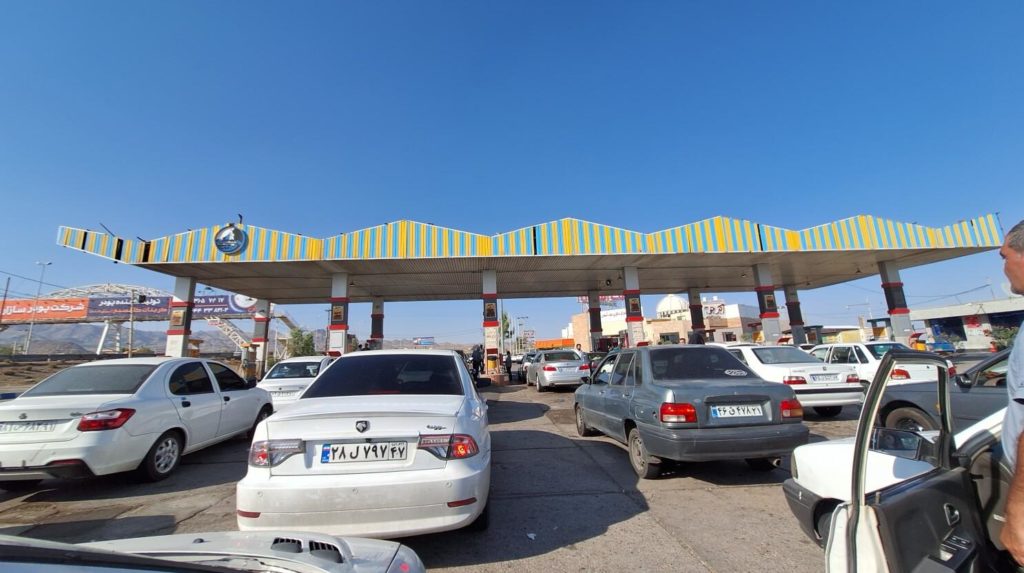
A long queue of cars waiting at a petrol station in Tehran, 13 June 2025.
Iran is now drawing on its strategic fuel reserves at a rate that informed sources describe as a “red alert”. If the withdrawals continue, some stocks could be exhausted within weeks. Behind the queues at petrol stations looms a far broader problem: how to keep the economy supplied, preserve military capabilities and prevent a petrol shortage from becoming the spark for a new social crisis?
In a country with some of the largest hydrocarbon reserves in the world, the image is politically devastating: motorists queuing outside petrol stations in Tehran while some pumps temporarily run out of petrol or diesel. The crisis does not stem from a lack of crude oil. It is the result of a chain of constraints: refining capacity damaged or disrupted by the war, domestic consumption exceeding petrol production, imports that have become more difficult and mounting pressure from US sanctions on trade and financial routes.
According to an investigation published on 26 August by Iran International, drawdowns from strategic fuel reserves have reportedly reached “red alert” level. The sources cited estimate that, at the current rate, some stocks could be exhausted within weeks. This assessment has not been confirmed by any official public inventory, but it comes as the Iranian authorities already acknowledge a substantial daily petrol shortfall.
How Washington tightened the noose
The current crisis did not emerge in a matter of days. It is the culmination of a cumulative strategy aimed less at depriving Iran of crude oil than at gradually cutting off its means of selling it, repatriating the proceeds and replacing what the country can no longer produce itself. Since the spring, Washington has tightened one strand of the net after another.
First, the United States targeted the shell companies, financial intermediaries, exchange houses and shadow fleet operators that allow Tehran to export its oil despite sanctions. Then the pressure turned maritime, with the US blockade and tighter control of export routes. In early August, the US Treasury went on to strike at the clandestine banking networks used to move foreign currency. On 24 August, Operation “Economic Outcast” went a step further by announcing a “zero leakage” approach: oil, shipping, aviation, gold, technology and digital assets are now all in its sights, with the threat of secondary sanctions against foreign partners that continue to act as conduits for Iran.
The intended effect is that of an economic siege. Exports bring in less foreign currency, payments are becoming harder, imports of refined products are shrinking and war damage to refineries is reducing domestic headroom. Iran is therefore not short of oil; it is increasingly short of the capacity to turn that wealth into steady flows of fuel and foreign currency.
It is the old story of besieged strongholds. They do not necessarily fall when the enemy breaches their walls, but when their reserves run out one after another. The decisive moment comes when the besieged begin living off their stocks rather than their normal supply flows. Iran’s hourglass is now measured in litres drawn from its strategic reserves.
A deficit becoming structural
Iran’s organisation responsible for the optimisation and strategic management of energy puts national consumption at around 135 million litres of petrol a day, against production of close to 120 million. The shortfall therefore stands at around 14 to 15 million litres a day. Until now, part of this gap was covered by imports and by stocks.
The Financial Times now describes queues in Tehran and notes that the war has damaged Iran’s refining capacity while import options are shrinking. US secondary sanctions are complicating payments and transactions, while disruption in Russia and along the Caspian routes is also reducing the alternatives.
The government is considering several responses: limiting the volumes delivered to filling stations, cutting subsidised quotas or charging for additional consumption at a price closer to the market rate. But each of these options shifts the problem without solving it. Rationing creates queues and tension; raising prices fuels inflation and discontent; continuing to drain the reserves merely postpones the day of reckoning.
On the military front: preserving fuel before preserving mobility
The military consequences should be assessed with caution. A shortage of civilian petrol does not mean that Iran’s armed forces are about to be brought to a standstill. The military uses different categories of fuel depending on the mission: diesel for many heavy vehicles and generators, aviation fuel — or jet fuel — for aircraft, and specialised products for certain equipment. The exact make-up of the strategic reserves now being drawn upon has not been made public.
Nor do all missiles and drones rely on the same stocks. A significant proportion of Iran’s ballistic missiles use solid propellants; other models use liquid propellants. Piston-engined drones, for their part, burn hydrocarbon fuels similar to those used in light aviation, while jet-powered drones run on aviation fuel. In January 2025, Reuters, citing the Financial Times, reported that two Iranian ships were due to carry more than 1,000 tonnes of sodium perchlorate from China, a precursor of the ammonium perchlorate used in solid propellants. This supply chain points to a separate vulnerability: even if the petrol shortage does not directly ground the missiles, the blockade and sanctions may hamper the supply of components needed to manufacture them.
By contrast, the depletion of the safety buffer is gradually changing the military calculus. As long as reserves are plentiful, the state can absorb a temporary disruption to refining or imports. Once they reach critical levels, it has to start prioritising consumers. The armed forces, the IRGC, air defences, the security services and strategic infrastructure will naturally come first. This means the shortage is likely to be shifted onto civilian uses before it directly affects military operations.
For military purposes, the problem emerges mainly over time. A protracted war consumes fuel to move units, resupply bases, run generators, transport munitions and keep coastal and air-defence systems on alert. If diesel also runs short, military logistics become more costly and less flexible. At this stage, however, there is no public evidence of any significant deterioration in Iranian operations directly attributable to a lack of fuel.
The IRGC’s stance is telling. According to sources cited by Iran International, the Guards oppose unrestricted use of the strategic reserves. Their reasoning is understandable: drawing down a critical share of available stocks today to keep civilian pumps open could leave the state without a safety margin tomorrow, in the event of a fresh strike, a disruption to imports or a military emergency.
The economy: diesel could become more dangerous than petrol
For Iran’s economy, the risk is not confined to private cars. Diesel fuels lorries, part of the public transport network, industrial and agricultural machinery and many generators. Recent footage already shows queues of heavy goods vehicles on the Haraz road, between Tehran and the north of the country, owing to problems with diesel supplies.
A prolonged shortage could therefore spread quickly: fewer lorries available, higher freight costs, delays in deliveries of foodstuffs and industrial parts, rising urban transport fares and additional pressure on businesses. In Tehran, residents have already reported a marked rise in ride-hailing fares when drivers are no longer able to refuel normally.
Fuel thus acts as an inflation multiplier: when its price rises or its availability falls, it pushes up the cost of almost every product that has to be transported. This dynamic is at work at a time when the rial has fallen sharply, food inflation is extremely high and household purchasing power has already collapsed. Associated Press notes that shops generally remain stocked, but that many Iranians can no longer afford what they find there.
The government therefore faces a double bind: subsidising petrol is becoming ever more costly for a state deprived of foreign-currency revenue, while cutting subsidies risks instantly turning a budget crisis into a social crisis.
Petrol, the latest shortage
For Iranians, the fuel crisis has not struck a country functioning normally. It comes on top of power cuts, water restrictions, the collapse of the rial and soaring prices. Energy and water shortages predated the current crisis, but the war, falling revenues and difficulties with imports are now eroding the government’s ability to cushion their effects.
The water situation shows the scale of this accumulation. Pressure reductions have already left districts of Tehran without water for several hours, while power cuts have multiplied during heatwaves. Reuters has described households facing shortages of water and electricity in turn. At the same time, inflation, the slide of the rial and rising food prices are eating into purchasing power.
It is this cumulative effect that worries the authorities. A power cut, a water restriction or a price rise can each be absorbed on its own. But when water, electricity, food, transport and fuel all start to fail at the same time, the economic crisis changes in nature: it becomes a crisis of confidence in the very ability of the state to keep daily life running.
The street: the memory of November 2019
In Tehran, no one has forgotten November 2019. The abrupt announcement of a rise in the price of petrol sparked protests in many cities, followed by an extremely violent crackdown. Since then, the price of fuel has no longer been merely an economic matter: it has become a political indicator of the first order.
This is probably one of the reasons why Masoud Pezeshkian’s government prefers to keep drawing on the reserves. Every litre released from the strategic stocks keeps a few pumps open, shortens the queues and puts off a decision on quotas or prices. But this strategy buys time by consuming the very mechanism that was meant to carry the country through an emergency.
The question then becomes a political one: what will happen when the government can no longer simultaneously protect the reserves, hold down prices and keep the filling stations supplied? The risk of economic crisis and social unrest converging is being taken seriously enough that the IRGC, the Basij and the police recently announced a large-scale security exercise in the capital. Reuters also reports that Iran’s leaders fear that any further tightening of economic pressure could reignite widespread unrest.
Pezeshkian and the IRGC fight over the last litres
Finally, the fuel crisis exposes a new fault line at the top of the regime. Pezeshkian thinks first and foremost as a political leader charged with keeping the economy running and averting a social explosion. The IRGC thinks as an institution engaged in a prolonged confrontation and intent on retaining a usable reserve in case of emergency.
Neither logic is absurd; they are simply becoming incompatible as stocks dwindle. The president wants to use the reserves to keep the shortage from becoming visible. The Guards want to stop them from running out. The battle is therefore no longer merely between advocates of negotiation and proponents of a show of strength: it is now about how to share out a strategic resource that has become scarce.
This divergence extends a question already raised in “Iran: who to negotiate with in Tehran?”: who really has the final say when military, economic and social priorities no longer align?
The American gamble: strangle without unleashing the uncontrollable
Washington is seeking to exploit precisely this contradiction. With Operation Economic Outcast, the new sanctions campaign aims to reduce oil revenues, block financial channels, close down evasion networks and deter foreign partners from trading with Iran. The objective is to drive up the domestic cost of the war until Tehran is forced into further concessions. The US Treasury now openly embraces a strategy of near-total economic isolation.
But this strategy also carries a risk. A fuel shortage does not hit only the leadership or the IRGC. It affects households, drivers, shops and supply chains first. If it becomes too severe, it may fuel protests that the regime will crush, but it may also trigger economic disruption whose effects will reach beyond Iran.
The paradox is now stark. Iran still has oil, but is beginning to run short of the fuel that keeps its economy running. Strategic reserves can delay the crisis, but cannot eliminate the shortfall. In a besieged fortress, time becomes a weapon once normal flows are no longer enough and one starts living off stocks. If reports that they will soon be exhausted are confirmed, the question will no longer be merely whether Tehran must ration, raise prices or give priority to the armed forces. It will be in what order the regime is prepared to make others pay for the war: the economy, the population or its own military apparatus — and how much sand is still left in the Iranian hourglass.
Read more in La Tribune des Nations
• Iran: who is there to negotiate with in Tehran?
• Hormuz: Iran holds the strait, Trump holds the purse strings
• Iran–UAE: behind the missile launches, the battle over the rules of Hormuz
Sources:
• Iran International, 26 August 2026: fuel reserves at “red alert” level
• Financial Times, 25 August 2026: queues and petrol shortfall in Iran
• U.S. Treasury, 24 August 2026: launch of Operation Economic Outcast
Translated from French. The French original prevails.