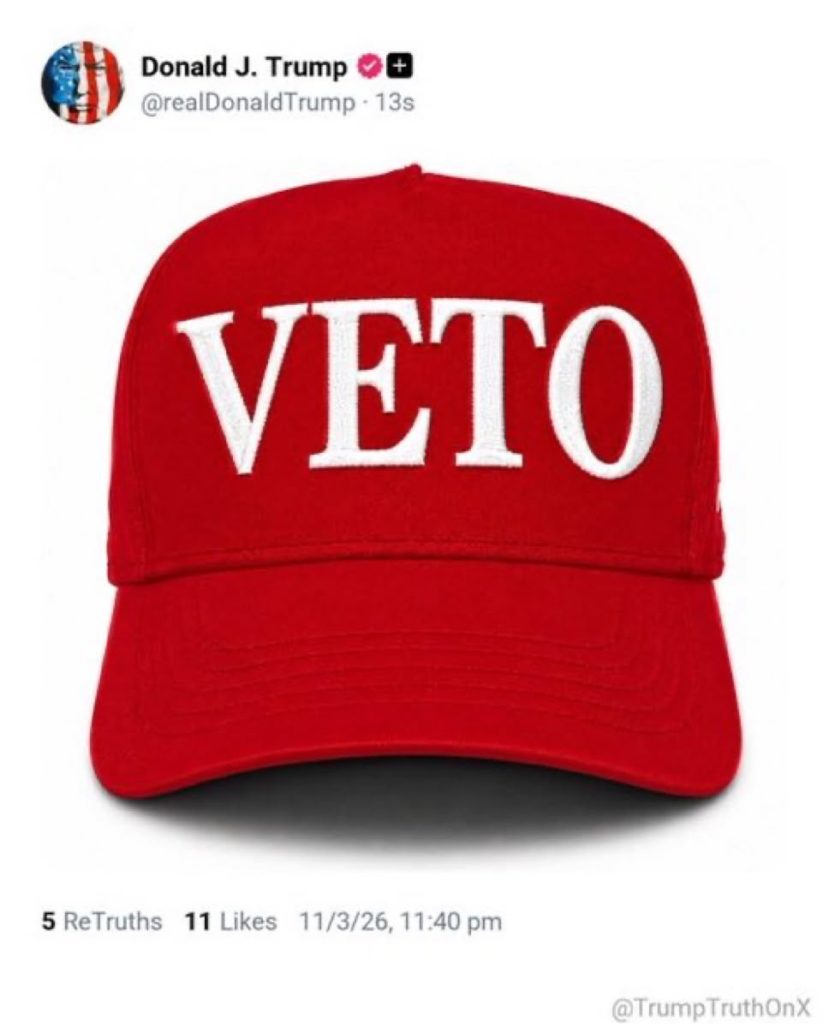
On the day the Republicans lost their majority in both houses of Congress, Donald Trump announced an end to annual military aid to Israel. The White House wants to halt the payments, but the funding is voted by Congress. A first clash could come as early as December, before the Democratic majority takes office.
On the evening of 3 November, as the results of the midterm elections came in, Donald Trump posted on Truth Social an image of a red cap bearing a single word, “VETO”. On Fox News, he explained that he intended to block certain Democratic bills in order to bring their authors to the negotiating table. A few hours earlier, on the same channel, he had announced that the United States would stop financing Israel’s military purchases after 2026. The cap was aimed at the incoming Congress. The Israel issue, however, could put each side’s powers to the test as early as the outgoing Congress’s session.
Netanyahu had contemplated an end to US funding
Trump says that Benjamin Netanyahu had raised the matter himself and that they had reached an agreement several months earlier. In January 2026, Jewish Insider reported, citing a source, that the Israeli Prime Minister had raised the possibility of forgoing all or part of the 2027 and 2028 instalments at Mar-a-Lago in December 2025. In June, on CNBC, Netanyahu publicly argued for a different timetable: begin the reduction during the last two years of Trump’s term, then gradually bring it down to zero. Whether payments will stop at the end of 2026 has yet to be confirmed. Trump explained why he was raising it on election day: he wanted to deprive his Democratic opponents of a campaign argument.
In Jerusalem, the outgoing Prime Minister had not publicly confirmed that date as of 5 November. As early as 3 November, his rival Gadi Eisenkot demanded an explanation of the circumstances surrounding the announcement. According to him, defence officials had learnt from the media of a change affecting the country’s security. The following day, after the Democratic victory, Eisenkot pledged to rebuild ties with both American parties if he formed the next government. He was thereby raising a practical question for Israel: whom should it turn to in Washington if the President and lawmakers disagree over funding?
Funding for Israel could spark a first showdown
The 2016 memorandum of understanding provides for an annual package of $3.8 billion until September 2028. Of this sum, $3.3 billion chiefly funds purchases of American military equipment and $500 million is earmarked for joint missile defence programmes. For fiscal year 2027, the White House was still proposing the $3.3 billion in April. The House kept it in its appropriations bill passed in July. The stopgap funding expires on 11 December. The law authorising it limits full disbursements at the start of the fiscal year. The outgoing Congress could therefore settle the matter before the new majority takes office on 3 January 2027.
Lawmakers can maintain the funds, reduce them or change the conditions attached to them. The president can veto the bill containing them. Overriding that veto requires a two-thirds majority in each chamber. The executive can also request the cancellation of funds already appropriated, which triggers a separate procedure. Trump has publicly taken a position on ending the subsidies. If lawmakers maintain the funds, he will have to decide whether to accept their decision. If they endorse the cut, they will share the political responsibility for it. Israel would then have to find a way to finance the instalments on certain orders already signed, even if American sales continue.
Democrats divided over support for Israel
On 15 July, the House rejected the amendment tabled by Republican Thomas Massie that would have eliminated the 3.3 billion in subsidies. Among Democrats, 103 voted in favour, including Nancy Pelosi, and 98 against, including Hakeem Jeffries. Ten voted “present”. In February, 65% of Democrats polled by Gallup said they sympathised more with the Palestinians, against 17% with the Israelis. The July vote shows the extent of disagreement in Congress over the means to be used. Some lawmakers could back the reduction announced by Trump while calling for greater oversight of arms sales. On the Republican side, Representative Abe Hamadeh welcomed the announcement the same day, advocating a relationship in which Israel would buy American weapons with its own funds.
Congress will also have to decide what form support for Israel takes
On 22 July, the House passed a defence bill providing for the appointment at the Pentagon of an official responsible for technological cooperation with Israel. The provision, which became Section 219, covers research, testing and co-production in particular. Thomas Massie and Democrat Ro Khanna sought to remove it. Republican Don Bacon took up the initiative again on 13 October in a separate bill. These bills set out the terms of industrial and technological cooperation. They make no provision for any automatic transfer of the procurement subsidies to these programmes.
The next budget bill will give a first indication of whether Congress is willing to follow or challenge Trump’s timetable. The vote on technology cooperation will show which lawmakers are prepared to deepen ties with Israel, even if subsidies fall. For the next Israeli government, the two decisions will have different effects: one will weigh on the financing of its orders, the other on the place of its industry in US defence programmes.
Sources and links
Reuters, the 3 November announcement · Continuing appropriations act, sections 106 and 109 · Don Bacon’s bill
Follow the author on X
Further reading from LTDN
Midterm results accelerate Trump’s Gulf agenda
Gulf: diplomats step up efforts to avert the worst
Translated from French. The French original prevails.