From Iraq to Hormuz and from Yanbu to Bab el-Mandeb, Saudi Arabia sees its entire oil chain under converging threats. But the noose is also tightening around the Houthis: the runway at Sanaa airport has been struck, Iranian supply routes are being monitored and disrupted, government and tribal forces are remobilising in Al-Jawf and Marib, while the Hodeidah front, on the Red Sea, is flaring up again. Two encirclements now face each other. Their outcome will depend on Riyadh’s ability to coordinate the action of its Arab allies with the American umbrella, and on Tehran’s ability to support the Houthis without provoking hostility from Baghdad, impatience in Beijing and a new military coalition in Yemen.
Smoke over Abqaiq
On 27 July 2026, an image from the European Copernicus Sentinel-2 satellite shows a large plume of smoke rising from an oil facility at Abqaiq, in Saudi Arabia’s Eastern Province. The image released by Reuters confirms that an incident occurred at the site, but it cannot, on its own, establish the cause, the extent of the damage or the origin of any attack.
During the same hours, the Saudi Ministry of Defence spokesman, General Turki al-Maliki, announced the interception of several kamikaze drones heading towards oil facilities in the Riyadh region and in the Eastern Province. Riyadh says the aircraft were launched from Iraqi territory by Iran-linked armed groups and reserves the right to respond “at the appropriate time and place”. The Saudi statement does not publicly specify which sites were targeted or how many projectiles hit their target.
Separately, the Houthis claimed an operation against several sensitive crude oil supply and transport facilities linking the east of the kingdom to the Yanbu export terminal on the Red Sea. Reuters reports that Aramco did not immediately comment on the claim. At this stage, it would therefore be premature to attribute the plume observed at Abqaiq to a drone from Iraq, a Houthi operation or an incident of another kind.
Caution over causality does not, however, diminish the strategic significance of the image. Abqaiq is no ordinary refinery. According to Aramco, the complex is the world’s largest crude oil stabilisation plant. It processes around half of Saudi Arabia’s daily output and accounts for nearly 5% of global oil supply. The smoke over Abqaiq thus brings the crisis back to the heart of the system: before it can be exported via Hormuz or the Red Sea, oil must first be processed, stabilised and transported.
Jazan: threat turns into industrial shutdown
In Jazan, on Saudi Arabia’s Red Sea coast, the consequences of the Houthi offensive are now more clearly established. According to a note from the specialist consultancy IIR seen by Reuters, Aramco suspended operations at its 400,000-barrel-per-day refinery on 27 July, following the attack carried out two days earlier.
The damage reportedly affected the integrated gasification combined cycle (IGCC) complex as well as the oil tank farm. Aramco is said to be seeking to complete repairs and restart the refinery around 15 August. This timetable has not, however, yet been directly confirmed by the Saudi company.
The Houthis had claimed responsibility for strikes on Aramco facilities in Jazan and Yanbu. Footage verified by Reuters had shown a large plume of smoke rising in the direction of the refinery, while trade sources reported possible damage to storage facilities.
The closure of Jazan marks a step change. The Houthis are no longer content merely to threaten Bab el-Mandeb or the vessels carrying Saudi oil. They are demonstrating their ability to halt, even temporarily, the operation of an industrial complex at the western end of the kingdom’s energy network.
Jazan is in a particularly sensitive position. The refinery lies close to Yemen, on the coastline towards which Saudi Arabia is seeking to divert part of its flows in order to bypass the Strait of Hormuz. The fallback route to the Red Sea is therefore under threat at several levels: onshore facilities, storage tanks, terminals, tankers and the Bab el-Mandeb passage.
The episode thus confirms the core of the Houthi strategy: there is no need to close the Red Sea completely in order to impose a cost on Riyadh. A sufficiently precise attack on a refinery or a storage site can reduce available capacity, tie up repair crews, force air defences to be strengthened and keep alive uncertainty about the next target.
The first encirclement: the Saudi oil chain
The term “encirclement” does not describe a conventional military siege. No regular army surrounds the kingdom, and no public evidence supports the claim that all the attacks follow a single operational plan dictated in real time from Tehran. The phenomenon is geographical and functional: separate threats successively hit production, processing, overland transport, terminals and the two sea routes used by Saudi oil.
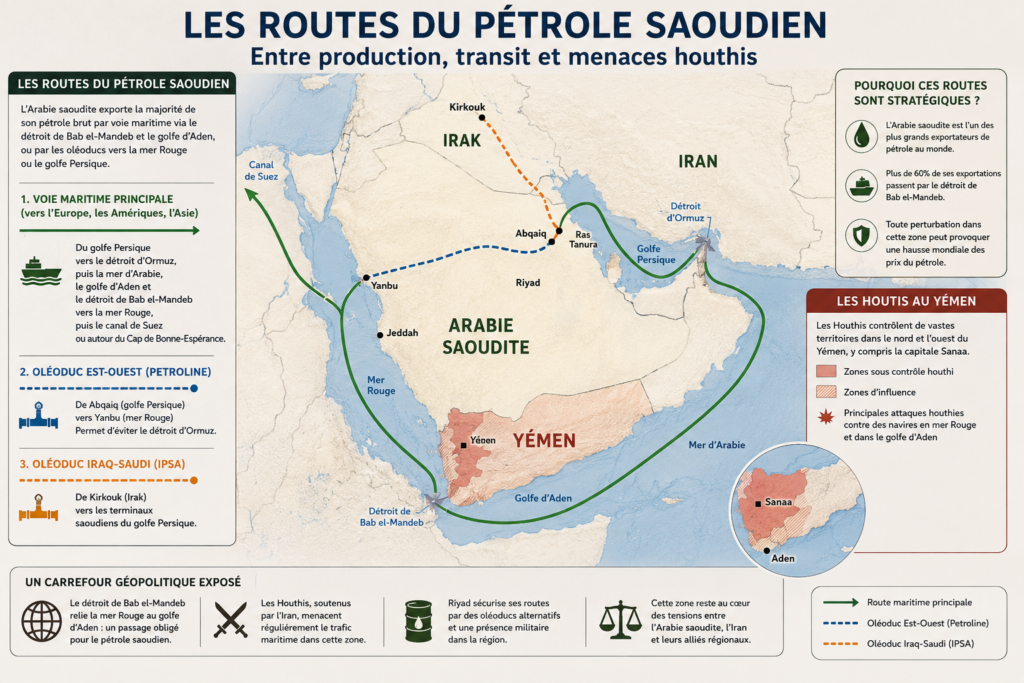
To the east, the closure or restriction of the Strait of Hormuz is undermining the traditional outlet for crude produced in the Gulf. To the north, drones launched from Iraq are now targeting the Eastern Province and the Riyadh region. To the west, the Houthis are threatening Yanbu, the Red Sea installations and Bab el-Mandeb. Inside the kingdom, the East-West Pipeline, its pumping stations and its processing centres are themselves becoming targets.
In a previous article in La Tribune des Nations, “After Hormuz, Bab el-Mandeb: the new front in the energy war”, we showed that the second strait was undermining the route chosen by Riyadh to bypass the first. The events of July now require a broader reading: the stakes are no longer confined to two maritime passages. It is the continuity of the entire Saudi oil chain that is being contested.
Hormuz: the first gateway
For several decades, Saudi strategy has rested on a simple idea: if Hormuz becomes impassable, the oil produced in the east of the kingdom must be able to cross the country and reach the Red Sea. Built during the Iran-Iraq War, the East-West Pipeline, or Petroline, links the Abqaiq region to Yanbu. Its maximum capacity has been raised to around seven million barrels a day.
Since traffic through Hormuz fell sharply, this back-up route has become the main artery of Saudi exports. The paradox is immediate: the more the Petroline proves its worth, the greater its value as a target. Iran does not need to close the strait for any length of time to impose a strategic cost. The threat alone is enough to divert flows, saturate alternative routes and further expose infrastructure whose locations and functions are well known.
The geography of vulnerability is shifting, but it is not disappearing. Hormuz pushes oil towards Yanbu; Yanbu leads to a threatened Red Sea; and the pipeline linking the two coasts is itself becoming a front.
Iraq: the opening of a northern front
The Saudi announcement of 27 July adds a new axis to this encirclement: drones were reportedly launched from Iraqi territory against oil facilities in the Eastern Province and the Riyadh region. Saudi Arabia attributes the operation to Iranian-backed armed groups. The precise identification of the cells, flight paths and launch points nevertheless remains to be established.
Baghdad’s response is nonetheless significant. Prime Minister Ali Faleh al-Zaidi has ordered an investigation based on the information passed on by the Saudi side. The statement published by the Iraqi News Agency reaffirms that Iraq will not allow its territory to be used as a route or launchpad against neighbouring countries, and promises to prosecute anyone whose involvement is proven.
Baghdad does not yet formally acknowledge that the drones came from Iraq, but it is no longer content simply to deny it. Above all, the government is seeking to protect a relationship with Riyadh that it describes as deep and fraternal. This situation leaves Baghdad facing a difficult choice: impose its authority on the armed factions or allow Iraq to become operational strategic depth against Saudi Arabia.
The investigation is a test for the Iraqi state. If it identifies and prosecutes those responsible, it risks a confrontation with networks linked to Iran’s Islamic Revolutionary Guard Corps (IRGC). If it fails, Riyadh could come to regard southern Iraq as hostile strategic depth and reserve the right to strike there. Either way, using Iraq as a lever of pressure becomes politically more costly.
Yanbu and Bab el-Mandeb: an incomplete but effective blockade
The Yanbu terminal has become the other main gateway for Saudi oil. It allows the kingdom to bypass Hormuz and ship crude to Europe via Suez or to Asia through Bab el-Mandeb. The Houthis have therefore chosen to threaten precisely the route that was meant to shield the kingdom from Iranian pressure in the Gulf.
Traffic plummeted to eleven merchant vessels on 26 July, its lowest level in several months, before recovering to twenty-eight vessels the following day. Kpler data reported by Reuters thus show that the strait is neither closed nor paralysed. Traffic nonetheless remains well below the peak of forty-six vessels recorded on 14 July.
The passage of the New Pearl is particularly telling. The Hong Kong-flagged very large crude carrier left the Red Sea carrying two million barrels of Saudi crude bound for Zhoushan, in China. Reuters describes it as the fourth Chinese supertanker to pass through Bab el-Mandeb since the Houthi blockade was announced. Other cargoes bound for China and Pakistan have also continued on their way.
This traffic qualifies the notion of an effective blockade. It may also point to a selective approach to risk: the Houthis have little interest in directly provoking Beijing, given that China is Iran’s main economic partner. It would nonetheless be going too far to claim that Chinese vessels enjoy safe passage. The transits observed prove only that Houthi threats are not applied uniformly and that some shipowners continue to accept the risk.
The Houthis do not need to physically close the strait. A handful of successful attacks, or the credible fear of further strikes, can be enough to push up insurance premiums, delay shipments and divert the most cautious vessels. The blockade can remain incomplete while still imposing a real economic cost.
The second encirclement: the Houthis under pressure
By threatening Bab el-Mandeb and Saudi exports, the Houthis have given Riyadh, the Yemeni government and several tribal forces a shared reason to reopen the front lines. On 16 July, Reuters reported that Tehran had asked the Houthis to stand ready to close Bab el-Mandeb if the United States struck Iran’s power grid. Missiles and drones were reportedly moved closer to the strait, while IRGC representatives present in Yemen were to take part in the decision. These contingency preparations explicitly tied the Yemeni front to the defence of Iranian territory.
The Houthi declaration of a naval blockade on 20 July turned these preparations into a direct threat against Riyadh. But it also left the movement exposed. As long as the Houthis confined themselves to one-off operations, Saudi Arabia could hesitate to embark on another long war. By claiming the ability to close the kingdom’s second energy gateway, they have made a response far more likely.
Sanaa and Hodeidah: Iranian routes become vulnerable
On 13 July, the runway at Sanaa International Airport was bombed when an Iranian aircraft was due to land there. The operation was claimed by the defence ministry of Yemen’s internationally recognised government; the Houthis blamed Saudi Arabia. The identity of the aircraft that carried out the strike has not been publicly established. According to Reuters, the Mahan Air plane, originally bound for Sanaa, eventually landed in Hodeidah.
Four sources cited by Reuters say the flight was carrying IRGC commanders and advisers, missile- and drone-related components, and gold intended to fund Houthi operations. Tehran and the Houthis have rejected these accusations, describing the passengers as civilians or members of a delegation returning from Iran.
This episode calls for precise wording. Iran’s supply routes have not been cut: the flight was diverted and reached Hodeidah. But they have become more visible, more exposed and easier to intercept. The runway at Sanaa is no longer a safe point of entry, while Hodeidah now combines the roles of port, substitute air hub and base of operations against shipping.
The Riyadh-led coalition has struck Houthi military targets in Hodeidah governorate following the attacks on Saudi vessels. In its statement of 25 July, it said it had not targeted the commercial port and presented the operation as a proportionate response against the assets used to threaten shipping in the Red Sea.
The west coast is thus becoming the weak point in the Houthi set-up. Hodeidah, Ras Isa and Salif are indispensable for civilian imports, but they have also long been suspected of being used to receive or assemble military components. The more the Houthis use the Red Sea as leverage, the more their coastal installations become legitimate targets in the eyes of their adversaries.
Al-Jawf, Marib and the west coast: spreading Houthi forces thin
The other arm of the counter-encirclement is on land. To the east, the Al-Jawf and Marib fronts are being reactivated. On the west coast, fighting has resumed south of Hodeidah, where the clashes in early July were described as the most violent in several years. Government forces, west coast units and anti-Houthi tribal networks do not form a homogeneous bloc, but their activity forces the movement to keep troops far from Bab el-Mandeb.
It is better to speak of tribal and government forces based in predominantly Sunni regions than to present all the tribes as a united religious front. Their loyalties are local, political and sometimes competing. Their military usefulness is nonetheless real: they can pin the Houthis down along several axes, threaten their inland routes and complicate the transfer of missiles and drones to the coast.
The Houthis must now protect Sanaa, the port of Hodeidah, their depots, their launch areas near the Red Sea and the Al-Jawf and Marib fronts. They remain capable of launching missiles and drones, but the opening of several fronts at once limits their room for manoeuvre. The Saudi counter-encirclement is less about swiftly capturing Sanaa than about forcing the movement to spread its resources thin.
Which of the two encirclements will take effect first?
The confrontation now takes the form of two mirroring encirclements. Iran and the groups close to it are seeking to threaten Saudi Arabia’s main oil routes and energy infrastructure simultaneously, from Hormuz to Bab el-Mandeb, by way of Iraq. Riyadh, in turn, is trying to hem the Houthis into their territory, complicate their resupply and force them to defend several fronts at the same time.
The balance of power, however, is no longer what it was in the early years of the war. Since the 2022 truce, Yemeni government forces and their allied formations have used the lull to regroup, rearm and strengthen their positions. Their command remains fragmented, but their equipment, readiness and coordination appear to have improved. Saudi Arabia is also working more closely with the various components of the anti-Houthi camp, while the mobilisation of the Al-Jawf tribes could lend additional depth to the eastern fronts.
This shift does not guarantee victory over the Houthis. They retain a more unified command, long combat experience, fortified positions in mountainous areas well suited to ambushes, and substantial missile and drone capabilities. But they would no longer be up against the divided, poorly equipped and inadequately coordinated forces of the early offensives. A new war could pit them against a better-armed force, capable of applying simultaneous pressure from Al-Jawf and Marib, on the west coast around Hodeidah and, possibly, from the southern provinces.
Pressure is also mounting on the Houthis’ supply routes. The strike on the runway at Sanaa airport and the diversion of an Iranian aircraft to Hodeidah show that air links can be cut or made more hazardous. The sea routes used to ship missile components, drones and military equipment are under closer surveillance. These routes have not been cut off entirely, but they are becoming more visible, more vulnerable and more costly to use.
The pressure on Houthi supply lines now extends beyond Yemeni territory. Iran is reported to have used Port Sudan as a staging post towards Al-Salif and Hodeidah, alongside routes through the Arabian Sea, the Gulf of Aden and the Horn of Africa. This channel has not necessarily been cut off: the Sudanese army still controls Port Sudan and has received Iranian military equipment. But it is becoming politically harder to use. The Sudanese government must choose between continuing its cooperation with Tehran and the economic and diplomatic support it is seeking from Riyadh and Washington. The war in Sudan does not, therefore, automatically close the African route for Iranian weapons; rather, it makes it a more uncertain and more exposed channel, one that could become a new arena of Saudi-Iranian pressure. The Houthis must therefore defend Sanaa, their ports, their depots, their launch sites and several land fronts, while keeping up the threat to shipping and to Saudi infrastructure. The more they concentrate their resources on the Bab el-Mandeb and the Red Sea, the more they risk weakening their positions in the interior of the country. Conversely, the more they reinforce Al-Jawf, Marib and Hodeidah, the less capacity they have immediately available to impose a genuine maritime blockade.
Saudi Arabia faces a similar dilemma. It must protect its oil facilities, pipelines, terminals and borders, while supporting Yemeni forces and avoiding being dragged into another interminable war. American and Arab defences can help reduce the threat, but their effectiveness will depend on how long operations last, on the availability of interceptors and on the actual level of coordination among Riyadh’s partners.
The central question therefore becomes this: will the Houthis manage to make Saudi energy routes sufficiently dangerous before their own supply lines, ports and land fronts come under unsustainable pressure? Or will Riyadh succeed in dispersing and containing their forces without once again becoming bogged down in a long and costly war?
The outcome will depend less on a decisive battle than on each side’s ability to sustain the effort over time. The Houthis are seeking to exhaust Saudi and American defences by multiplying the threats. Riyadh is seeking to force them to spread their resources thinly and to use up their reserves on several fronts. The war of the two encirclements will therefore also be a war of endurance.
Tehran holds talks with Riyadh and Oman
Even as Riyadh was condemning the attacks launched from Iraq and Yemen, Abbas Araghchi, the Iranian Minister of Foreign Affairs, was holding separate talks with the Saudi Minister of Foreign Affairs, Faisal bin Farhan, and his Omani counterpart, Badr al-Busaidi. According to the readout reported by Reuters, the discussions focused on security in Hormuz, cooperation and diplomatic efforts aimed at restoring regional stability.
No reopening of the strait has been announced. The dialogue shows, however, that Saudi Arabia is no longer merely a target or an ally of Washington: it is becoming a direct interlocutor of Tehran on the main lever of the crisis. Iran is clearly seeking to retain Hormuz as a bargaining tool without causing an irreversible rupture with Riyadh.
This two-tier diplomacy does not establish coordination between Tehran and the perpetrators of the attacks. Rather, it reveals Iran’s strategy: maintaining indirect military pressure while leaving open a political door capable of preventing a broader regional coalition.
Is China’s patience reaching its limits?
China has not publicly condemned Iran and continues to support Iranian sovereignty. Its tone is nevertheless becoming more direct. On 24 July, Wang Yi asked Abbas Araghchi, Iran’s foreign minister, to pursue negotiations and to “appropriately handle” issues relating to the Strait of Hormuz. The wording is diplomatic, but it is addressed to Tehran and responds to the international community’s concerns about shipping.
Beijing has not publicly blamed Iran for Bab el-Mandeb. Its interests are nonetheless directly affected. Saudi crude loaded at Yanbu and bound for China must pass through the strait, while the disruption in Hormuz is also affecting Iraqi, Qatari and Emirati cargoes heading to Asia. Iran’s pressure strategy is therefore beginning to hit Tehran’s main economic partner.
The passage of several Chinese supertankers shows that Beijing is seeking to maintain its supplies despite the risk. It also confronts the Houthis with a limit: striking these vessels directly would turn a crisis with Riyadh into a problem with China. For Tehran, the most effective constraint may therefore come not from Washington, but from a partner unwilling to see the two great energy gateways between the Middle East and Asia become unusable for any length of time.
The American umbrella put to the test by stockpiles
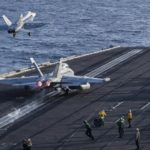
Saudi strategy assumes that, in the event of a major escalation, American defences will reinforce those of the kingdom and the other Gulf states. The United States has destroyers equipped with the Aegis system in the region, tasked with detecting, tracking and intercepting missiles and drones threatening its forces, shipping lanes and, depending on their positioning, certain allied infrastructure. It also has fighter jets, Patriot and THAAD batteries and electronic warfare capabilities. But this umbrella is neither automatic nor unlimited.
Exact inventories are classified. An analysis by CSIS published on 27 July nonetheless estimates that US stocks have fallen below the threshold of 1,000 Patriot interceptors, with more than 1,500 reportedly already fired since the start of the war. THAAD stocks are thought to have fallen to around 250, after an estimated 200 to 290 missiles were used during the first phase of the 2026 war. More than 150 had already been fired at Iranian missiles in June 2025. These figures are public estimates, not official data. They nevertheless show that Washington must now make trade-offs between the Middle East and preserving capabilities intended for a possible crisis in the Pacific.
The United States is not running out of missiles. According to the CSIS, it retains sufficient capabilities for the plausible scenarios of the current war. But it can no longer defend every pumping station, every ship and every base as though interceptors were available in unlimited supply. A ballistic missile aimed at Abqaiq or a US base will take priority; a slow drone heading for a secondary facility may be left to Saudi air defences or dealt with by cheaper means.
This constraint favours saturation strategies. Even when most of the projectiles are destroyed, the attacker forces its adversary to use up scarcer and more expensive missiles. The question is therefore no longer merely technical. It is industrial: how long can the United States and its allies sustain a high rate of interceptions?
Arab solidarity of variable geometry
The political framework exists. The Gulf Cooperation Council (GCC) repeatedly states that the security of its members is indivisible and has condemned the Iranian attacks as well as the Houthi threats against Bab el-Mandeb. The United Arab Emirates has affirmed its full solidarity with Saudi Arabia and its support for the measures taken by Riyadh to protect its security and freedom of navigation.
This political solidarity does not mean an automatic return to the 2015 coalition. Saudi and Emirati priorities in Yemen are not the same. Riyadh backs the internationally recognised government and seeks to secure its border. Abu Dhabi notably backs separatist forces in the South, whose political project is at odds with the preservation of a unified Yemen championed by the central government.
The Emirates can share intelligence, step up maritime surveillance and contribute to air defences without signing up to a new ground campaign led by Riyadh. Oman and Qatar favour mediation. Kuwait and Bahrain already have their own territory to protect. Egypt has a vital interest in the security of the Red Sea and the Suez Canal, but no significant Egyptian military involvement against the Houthis has been confirmed.
The weakness of the Saudi camp therefore remains its fragmented command. Iran can open several fronts by relying on actors that enjoy relative autonomy. The GCC must coordinate six foreign policies, several defence systems and differing perceptions of the Iranian threat. The encirclement is regional; the response remains largely national.
Saudi-US nuclear deal stokes fresh tension in the Gulf
Arab solidarity could also be tested by the civil nuclear cooperation agreement announced between Washington and Riyadh. According to Reuters, the text reportedly includes neither a binding renunciation of enrichment and reprocessing nor the IAEA Additional Protocol, which allows more intrusive inspections. Its entry into force remains uncertain, not least because of congressional oversight and the political conditions added by Donald Trump.
The difference matters to the Emirates, which in 2009 accepted the American “gold standard” – a legally binding renunciation of uranium enrichment and nuclear fuel reprocessing on their territory – whereas Saudi Arabia appears to have secured less restrictive terms. The agreement strengthens the strategic partnership between Washington and Riyadh in the face of Iran, but it may also prompt Abu Dhabi to demand equivalent terms. The Arab front is therefore not free of technological competition and rivalry over status.
Tehran is already exploiting this asymmetry by denouncing an American double standard: Washington is seeking to limit Iran’s nuclear capabilities while offering Saudi Arabia a more flexible framework. The argument is politically effective, even though the Saudi programme has yet to be built and remains subject to American and international procedures.
Two vices, a single race against time
Iran and the groups close to it are seeking to trap Saudi Arabia in a geography of energy threats. When Hormuz is threatened, Riyadh turns to Yanbu. When Yanbu becomes central, the Houthis threaten the Red Sea. When the kingdom concentrates its defences in the south and east, drones appear from Iraq. When the export routes hold firm, processing centres and pumping stations become targets once again.
Riyadh, in turn, is trying to hem the Houthis into their own territory: preventing the re-establishment of an Iranian air bridge to Sanaa, monitoring arrivals at Hodeidah, striking assets that threaten shipping, remobilising the Al-Jawf and Marib fronts and keeping up the pressure on the west coast. The movement can still receive support and launch weapons, but its routes are now more exposed and its fronts more numerous.
The war of the two encirclements will not be decided by firepower alone. It will hinge on four factors: the logistical resilience of the Houthis, the cohesion of the anti-Houthi Yemeni forces, how long the United States can keep supplying interceptors and Riyadh’s ability to turn Arab solidarity into an operational set-up.
Finally, it will depend on Tehran. Iran can use Hormuz, the Iraqi groups and the Houthis to raise the cost of the war. But this strategy is already provoking its own reactions: Baghdad is opening an investigation, Beijing is calling for Hormuz to be handled appropriately, Riyadh is talking directly to Araghchi and the Yemeni fronts are stirring. The encirclement of Saudi Arabia may succeed in unsettling the markets; it may also hasten the isolation and counter-encirclement of Iran’s main regional ally.
The real question, then, is no longer whether either side can close a strait entirely or rapidly capture a capital. It is which of the two systems will give way first: the Saudi oil chain under pressure or the Houthi apparatus stripped of its freedom of manoeuvre.
Articles from La Tribune des Nations worth reading
• After Hormuz, Bab el-Mandeb: the new front in the energy war
• After Hormuz, Bab el-Mandeb: the land front that could reshuffle the deck
• Hormuz: negotiation has given way to armed intimidation
• The United Arab Emirates: the pursuit of strategic autonomy
External references
• Iraqi News Agency: investigation into drones launched from Iraqi territory, 27 July 2026
• Reuters: IRGC officials and missile components transferred to the Houthis, 23 July 2026
• Reuters: partial resumption of traffic in Bab el-Mandeb and passage of the New Pearl, 28 July 2026
• Chinese Ministry of Foreign Affairs: meeting between Wang Yi and Abbas Araghchi, 24 July 2026
Translated from French. The French original prevails.