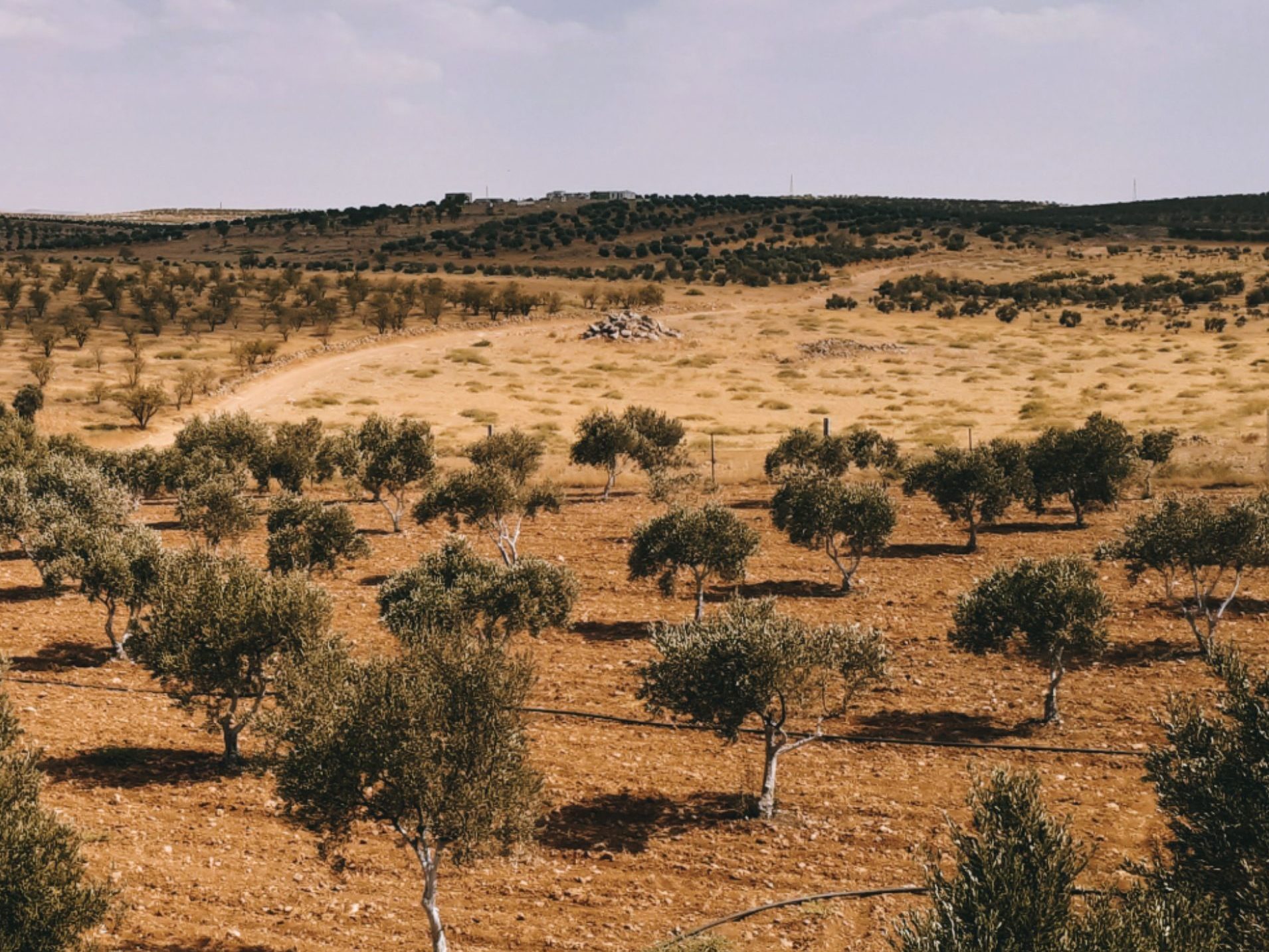
Beyond homes, roads and infrastructure, the war in southern Lebanon is also striking the olive groves, one of the country’s oldest agricultural memories. Between destruction, contaminated soil, lost harvests and accusations that ancient trees have been moved to Israel, an entire economic, social and cultural heritage is under threat.
A war against villages, but also against the land
In southern Lebanon, the war is not only destroying homes and infrastructure. It is also attacking the country’s living memory: the farmland, orchards and olive groves that for generations have underpinned the economy and identity of the border villages.
Since the Israeli-Lebanese front opened in autumn 2023, followed by the military escalation of 2024-2026, many agricultural areas have been set ablaze by bombardments, razed by military vehicles or rendered unfit for cultivation by unexploded ordnance and toxic residues. Amnesty International documented the extensive destruction of civilian property and farmland in southern Lebanon between October 2024 and January 2025, notably using bulldozers and explosives.
The damage is therefore not confined to buildings. It also affects what allows residents to return, work and rebuild a normal life. In several border villages, losing a home is already a tragedy. Losing the olive trees, the soil and the ability to harvest at the same time jeopardises the very possibility of return.
The olive tree, backbone of the rural economy
According to the assessment carried out by the FAO and the Lebanese Ministry of Agriculture, Lebanon’s agricultural sector has suffered around $118 million in direct damage and $586 million in production losses. Reconstruction and recovery needs are estimated at $263 million, of which $95 million is a priority for the 2025-2026 period.
Olive groves are among the worst-affected crops. The Lebanese environmental report, cited by The Guardian, records 2,154 hectares of orchards destroyed, including 814 hectares of olive groves. These figures give a sense of the scale of the shock: this is not merely a matter of harvests lost for one season, but the destruction of agricultural capital that can sometimes take several decades to rebuild.
In many villages in southern Lebanon, olive growing is an essential source of income. It supports farmers, farm labourers, mills, small traders and the entire olive oil production and marketing chain. When the trees burn, when the fields become inaccessible or when harvests can no longer be brought in, an entire local economy collapses.
Deir Mimas, Kawkaba: trees that predate modern borders
In Deir Mimas and Kawkaba, the significance of this destruction goes beyond the economy. Several local and industry sources describe the olive trees of Deir Mimas as centuries old, with some reputed to be more than 2,000 years old. The local company Terra Deir Mimas speaks of more than 150,000 olive trees, some of them over two millennia old, while Darmmess stresses the central role these trees play in the village’s identity.
In Kawkaba too, local heritage sources highlight olive trees said to be around 2,000 years old. Such estimates must of course be treated with caution: the exact age of such trees is hard to establish without thorough scientific assessment. Their heritage value, however, is scarcely in doubt. Local people regard these olive trees as witnesses to the biblical world, sometimes describing them as dating from the time of Christ.
These trees are therefore not merely features of the landscape. They are living archives. They carry the memory of families, of inherited land, of communal harvests, of farming practices and of social rituals. In a country where history is so often contested by force of arms and by borders, the olive tree remains a symbol of rootedness.
Accusations of uprooting and removal to Israel
The Lebanese authorities also accuse Israel of uprooting ancient olive trees and moving them to its own territory. This accusation, echoed by Lebanese officials and by some local sources, must be treated with caution as long as access to the border areas remains restricted and independent verification remains difficult.
In an interview cited by Mundo América, Lebanon’s Minister of Agriculture spoke of the theft of several thousand trees, with estimates ranging from 5,000 to 10,000 olive trees. This figure, significant and politically sensitive, cannot be presented as definitively established. (1)
But the accusation itself is telling. In the context of southern Lebanon, uprooting an ancient olive tree is not simply a matter of moving a tree. It means removing a landmark, a proof of presence, a source of income and a symbol of continuity. That is why the question of the olive trees touches at once on the law of war, the protection of heritage, the rural economy and collective memory.
Contaminated soil, white phosphorus, glyphosate: a lasting environmental crisis
The agricultural crisis is also part of a wider environmental crisis. Lebanon accuses Israel of having used destructive or contaminating substances in several areas of the south. Le Monde reported in February 2026 that Lebanese tests had confirmed the presence of glyphosate at very high concentrations in some areas close to the demarcation line, raising concerns about soil fertility and the resumption of farming.
The report by Lebanon’s National Council for Scientific Research, also cited by The Guardian, describes ecological destruction on a large scale: burnt forests, devastated orchards, soil contamination, damage to biodiversity and risks to food security. Yet olive groves play an essential role in stabilising soil and preventing erosion. Their loss leaves the land exposed to rapid degradation and weakens the ability of ecosystems to regenerate.
Unexploded ordnance is another major obstacle. Even when the fighting subsides, farmers cannot always return to their fields. The land remains dangerous, harvests are delayed or abandoned, and families are reluctant to resume normal life in areas where drones, sporadic gunfire and the risk of explosions persist.
Olive harvest, a social ritual under threat
The olive harvest is no ordinary farming activity. In southern Lebanon, as in much of the Levant, it is a collective occasion. Families gather, neighbours help one another, the young learn the skills of their elders, the olives are taken to the mill, and the oil then becomes at once a foodstuff, a source of income and a symbolic store of value.
This is borne out by several reports from the ground, notably one by Al Jazeera on farmers in the Marjayoun area, who sometimes have to harvest under military surveillance and amid a climate of insecurity. The loss of the olive groves therefore undermines social structures as much as incomes. It deprives villages of occasions for gathering, for passing on knowledge and for solidarity.
In a region already scarred by displacement, the destruction of homes and political uncertainty, this gradual disappearance of farming rituals is hastening the erosion of the social fabric. The olive tree is not merely a productive tree: it is one of the last tangible links between the inhabitants, their land and their family history.
Restoring the olive groves, restoring the return
In response, local initiatives, municipalities, NGOs and international organisations are trying to assess the damage, preserve the trees that are still alive and launch replanting programmes. But these efforts face three major obstacles: persistent insecurity, a lack of funding and difficulties in reaching the affected areas.
Replanting will not be enough in the short term. A young olive tree cannot replace one that is several centuries old. It takes years, sometimes decades, to recover yields and ecological stability. It will also be necessary to decontaminate the land, clear mines, secure access, compensate farmers and document the loss of heritage.
The reconstruction of southern Lebanon cannot, therefore, be confined to buildings. It will have to encompass the land, the trees, the mills, the irrigation networks and the agricultural landscapes. For in this region, the return of its inhabitants depends not only on an end to the fighting. It also depends on the possibility of making a living from the land once more.
A living memory under threat
The war has turned the olive trees of southern Lebanon into symbols of a deeper violence: one that strikes at the very conditions for return. A house can be rebuilt. A road can be repaired. But a thousand-year-old olive tree, once burnt, uprooted or moved, cannot be replaced.
In Deir Mimas, Kawkaba, Merjayoun, Bint Jbeil and the border villages, the olive trees tell a story that goes beyond agriculture. They tell of a country’s continuity, of its communities’ deep roots and of the silent memory of entire generations. To protect them is to defend part of Lebanon’s heritage. To lose them is to watch part of southern Lebanon itself disappear.
(1)This figure must remain attributed to the Lebanese authorities and to the sources reporting it.
Further reading – La Tribune des Nations
• Israeli army takes Beaufort Castle and dominates region in southern Lebanon
• Hezbollah raises the spectre of civil war: who would really help the Lebanese army disarm it?
Further reading: articles and reports from external sources
• Amnesty International – Israel’s extensive destruction of southern Lebanon
• FAO / Ministry of Agriculture – Lebanon Agricultural Damage and Loss Assessment Report
• The Guardian – Lebanon accuses Israel of committing “ecocide”
Additional sources cited in the text
• Le Monde – Lebanon condemns Israeli glyphosate attack in the country’s south
• Al Jazeera – Olive farmers face danger and neglect after Israel’s war in southern Lebanon
• Terra Deir Mimas – Age of Our Olive Trees
• Lebanon Untravelled – The oldest olive trees in Kawkaba
Translated from French. The French original prevails.