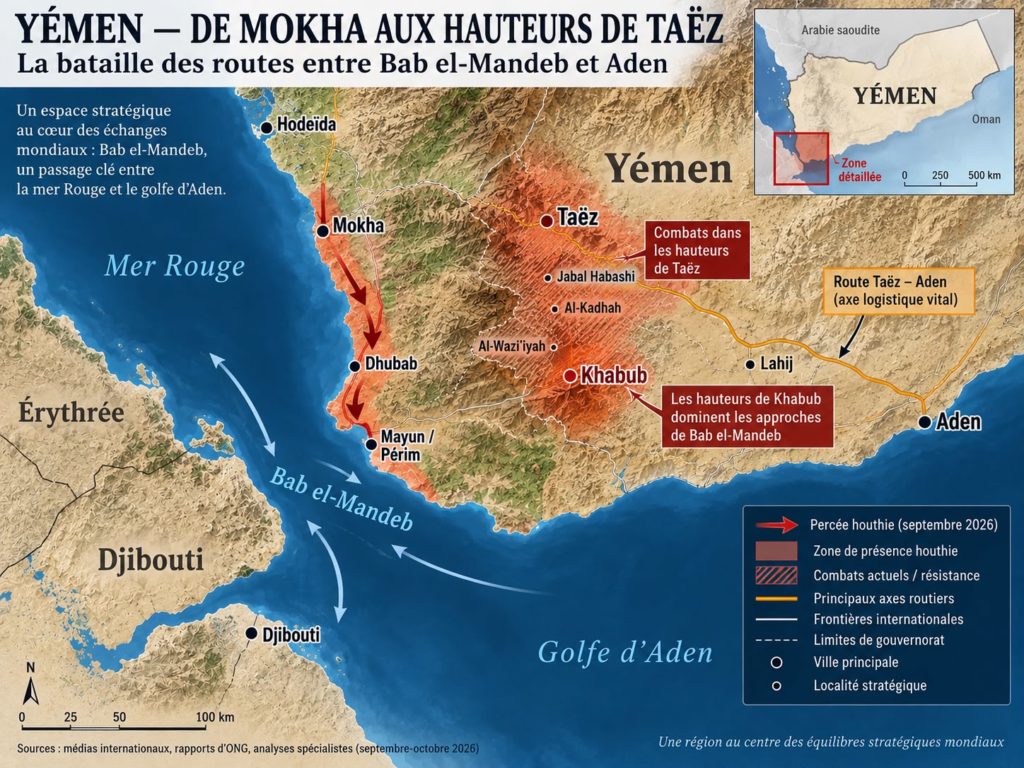
Map produced with AI.
The fighting now under way in south-western Yemen, around Bab el-Mandeb and the heights of Taiz, is no mere clash in some exotic, far-off land. It could affect freedom of navigation on one of the most strategic shipping routes in the world. Having reached Bab el-Mandeb, the Shia Houthi rebels are now up against an anti-Houthi camp that is trying to regroup, cut off their reinforcements and regain the initiative with growing Saudi support.
The Houthi breakthrough in September towards Mokha, Dhubab and Bab el-Mandeb triggered the collapse of government forces on the western front. Three weeks on, the picture is more complex. The Houthis have gained new depth along the Red Sea coast, but their advance towards the heights of Taiz and Lahij is meeting more organised resistance. Government forces, Tareq Saleh’s National Resistance, the Giants Brigades and the Homeland Shield are now attempting to coordinate their operations and strike reinforcements before they reach the front. Behind this battle, a sharper regional confrontation is also emerging: Iran’s IRGC (Islamic Revolutionary Guard Corps) helped prepare the offensive on Mokha, while Saudi Arabia is stepping up its support for the government camp.
Mokha: Houthi victory exposes opponents’ weaknesses
Yet at the beginning of September, the government camp had reinforced the Taiz and west coast axes. The Giants Brigades and the Homeland Shield forces joined the front, while General Hamdi Shukri arrived in Mokha to coordinate operations. The aim was to regain the initiative around Al-Kadhah, Maqbanah and Hays. The manoeuvre backfired. By spreading their resources across several axes, the anti-Houthi forces exposed weaknesses that the Houthis exploited. Their counter-offensive outflanked the opposing lines and opened the road to Mokha, then to Dhubab and Bab el-Mandeb.
The speed of the collapse exposes a long-standing weakness: these forces are fighting the same enemy without all answering to the same chain of command. The National Resistance, the Giants Brigades, the Homeland Shield forces, the Taiz units, the tribes and the southern formations have different structures and sometimes different objectives. In Mokha, material superiority did not make up for this lack of operational cohesion.
The southern question: fighting together without sharing the same Yemen
Compounding this military fragmentation is the southern question. The Southern Transitional Council, long backed by Abu Dhabi, has been considerably weakened by clashes with Riyadh-backed forces, but South Yemeni separatism has not gone away. Its political goal remains distinct from that of the supporters of a unified Yemen.
Above all, several formations born of this military architecture remain indispensable in the fight against the Houthis. The Giants Brigades, historically backed by the United Arab Emirates, are among the strongest units deployed on the Taiz and Lahij fronts. They are now fighting alongside other components of the government camp to prevent an advance on Aden.
The paradox is therefore central: these forces can share the same enemy without sharing the same vision for the country’s future. Military urgency is driving coordination; it does not settle the political question of independence for the South.
IRGC behind push towards the Red Sea
Reuters has established, on the basis of Yemeni, Iranian and regional sources, that the Houthi offensive on Mokha benefited from direct advice from the Islamic Revolutionary Guard Corps. Iranian officers reportedly helped to prepare the campaign and to coordinate the use of drones and other strike capabilities. The agency names in particular Abdolreza Shahlaei, a senior official in the Quds Force, although his personal role has not been independently confirmed.
Tehran denies directing Houthi operations and the Houthis insist on their autonomy. It would therefore be going too far to speak of an Iranian operation carried out by proxies. But the IRGC’s reported involvement shows that Iran can help to design an offensive whose consequences extend beyond Yemen.
Mokha and Bab el-Mandeb extend towards the Red Sea the pressure already being applied at Hormuz. The strategic depth gained by the Houthis threatens a shipping route on which Saudi Arabia relies precisely to reduce its vulnerability in the Gulf.
Bab el-Mandeb: reaching the strait does not mean controlling it
The capture of Mokha, followed by the Houthis’ arrival at Dhubab, was a strategic success. But reaching Bab el-Mandeb does not mean controlling its approaches over the long term.
The Houthi presence still appears unevenly consolidated. Reports from the ground describe scattered groups rather than a continuous network of fortified positions. Critical Threats Project also notes that Saudi or government strikes have helped to stabilise certain lines and to disrupt the Mokha–Dhubab axis.
To hold the area, the Houthis must control the high ground overlooking the roads, protect their supply lines and prevent opposing forces from returning from Taiz, Lahij and Aden. The battle has therefore shifted from the coast to the mountains.
Taiz: encirclement takes shape along the roads and the high ground
Taiz is not completely encircled. It is, however, under threat of operational encirclement. Rather than seeking to conquer this large city immediately, the Houthis may try to seize the high ground and cut the roads. The fighting stretches from Al-Wazi’iyah to Al-Kadhah, Bani Umar, Bani Bakari and Jabal Habashi, and on towards the approaches to Lahij. Whoever holds this high ground controls observation and movement on the roads, and often the use of artillery.
The Taiz–Aden link is the real linchpin. A lasting cut would deprive the defenders of part of their reinforcements, fuel and ammunition. That is why the battle for the high ground now matters more than the spectacular capture of a few towns and villages.
After the shock, anti-Houthi forces regroup
As early as 10 September, Tarek Saleh ordered the West Coast forces to close ranks and set up an alternative command centre, in coordination with the Presidential Leadership Council and the Riyadh-led coalition. He named the National Resistance, the Giants Brigades, the Homeland Shield and the units of the Taiz axis. A Tihama Resistance Force was subsequently formed under the command of General Zayed Munasar. It enjoys financial, administrative and operational autonomy, but reports directly to the Arab coalition’s joint operations. The aim is clear: to get forces that, at Mokha, had fought without any real unity of command to act together.
The early gains remain tactical. Government forces say they have retaken some high ground, including Jabal Nu’man, and stabilised several routes between Taiz and Lahij. The collapse seen at Mokha appears to have been halted, although it is still too early to speak of a general counter-offensive.
New tactic: strike reinforcements before they reach the front
The most significant change may be less visible on the map. Rather than waiting for Houthi units on the contact lines, government forces are now seeking to strike their reinforcements, depots and supply routes deep behind the lines. On 2 October, the government spokesman announced twenty air strikes in three hours against Houthi fighters, vehicles and equipment in Taiz province. Other waves of strikes had preceded this operation. At the same time, the authorities closed some nineteen roads into Taiz and declared them military zones.
The logic is that of an interdiction campaign: spot a column before it arrives, strike it with aircraft or drones, then prevent fresh forces from massing. The precise tallies of equipment destroyed remain, for the most part, government claims; the intensification of the air campaign, however, is documented. This pressure is forcing the Houthis to split up their convoys, take secondary roads, favour night-time movements and rely more heavily on infiltration.
When the war is fought at checkpoints and in disguise
At the end of September, local media reported that a man described as a Houthi fighter had been arrested while trying to enter Taiz disguised in women’s clothing. Photographs circulated, but neither his identity nor his membership of the Houthi movement has been independently confirmed. The episode should therefore not be treated as military evidence. It does, however, illustrate a broader phenomenon: when the main roads become dangerous, the war shifts to back roads, checkpoints, clandestine networks and individual infiltration.
Houthi threat draws Riyadh and Abu Dhabi closer
The new Houthi offensive is also having an unexpected effect in the Gulf: it is drawing Saudi Arabia and the United Arab Emirates closer together. The two coalition partners had been deeply divided over the future of South Yemen, with Riyadh backing government structures while Abu Dhabi had long favoured the Southern Transitional Council and several local military formations.
The capture of Mokha and the threat to Bab el-Mandeb have, however, shifted priorities. On 29 September, the Emirati Vice-President, Mansour bin Zayed, travelled to Riyadh to meet Mohammed bin Salman and the Saudi Defence Minister, Khalid bin Salman, the first Emirati visit at that level since the rift between the two capitals. According to the “Financial Times”, Riyadh wants, among other things, the Emirates to use their influence over the southern factions to help rebuild a more coherent anti-Houthi front. It is still too early to speak of an Emirati military return to Yemen or of a joint Saudi-Emirati command. But the paradox is telling: by threatening Bab el-Mandeb, Taiz and the approaches to Aden, the Houthis could end up helping to close the rift between Riyadh and Abu Dhabi that their offensive had exploited so effectively.
Riyadh steps up its involvement
During the Houthi breakthrough towards Mokha, the Yemeni government was calling for more air support. Reuters reported at the time that Riyadh was still limiting its direct involvement, not least for fear of provoking fresh Houthi strikes on its territory. Since then, the calculation has changed. Saudi Arabia is supporting government forces with intelligence, logistics and air support. At the same time, the fighting around Taiz has been accompanied by far more intense air activity. Riyadh has also just granted $60 million to the Yemeni government to support its budget and institutions.
The Kingdom is not, however, returning to the massive campaign it launched in 2015. Its aim appears more limited: to prevent the Houthis from turning their coastal victory into strategic control of south-western Yemen, to protect the road to Aden and to reduce the threat to Bab el-Mandeb.
From Mokha to Taiz: Riyadh and Tehran step out of the shadows
The contrast between the two phases is striking. At Mokha, Iranian operational support was stepped up while the anti-Houthi camp remained divided and Riyadh was still limiting its involvement. The result was a spectacular breakthrough all the way to Bab el-Mandeb. In Taiz, the Houthis retain Iranian backing, but their opponents are trying to correct the mistakes of September: better-coordinated command, reorganised forces, increased air support and priority given to cutting off reinforcements. This adaptation does not yet amount to a reversal of the balance of power, but it has prevented an immediate repeat of the Mokha scenario.
Yemen is thus once again becoming a more visible theatre of the regional confrontation between Iran and Saudi Arabia, without being reducible to a proxy war. Yemeni actors retain their own interests, but their backers are weighing ever more directly on their ability to prepare and sustain operations.
From a war over territory to a war over roads
The victory at Mokha may have marked the high point of the Houthi offensive rather than the beginning of a general collapse of the government camp. The Houthis captured Mokha and reached Bab el-Mandeb. To hold on to these gains, they must now control the mountains, the roads and the supply lines. Their opponents appear to have drawn an initial lesson from the defeat: there is no need to retake every lost kilometre immediately if the enemy can be prevented from resupplying the kilometres it has just conquered.
This is now the real stake in Taiz. If the Houthis cut the links to Aden for any length of time, their coastal breakthrough will gain new depth. If government forces hold the high ground and deny them the supply routes, Mokha may come to look like the high-water mark of an offensive that the Houthis failed to turn into lasting control of south-western Yemen.
Further reading from La Tribune des Nations
• From the Gulf to Yemen: the US-Iran war reawakens the Sunni-Shia divide
• Yemen: is Riyadh preparing to prevent a “Houthi Hormuz” at Bab el-Mandeb?
• After Hormuz, Bab el-Mandeb: the land front that could reshuffle the deck
• After Hormuz, Bab el-Mandeb: the new front in the energy war
• Yemen: a war on many fronts in which the Houthis remain the main beneficiaries
Main external sources
• Reuters — Iranian arms and advice helped Yemen’s Houthis seize key Red Sea city, 10 September 2026
• Reuters — Yemen carried out 20 strikes on Houthi targets in Taiz province, 2 October 2026
• Yemen Monitor — Tareq Saleh restructures forces on the western coast, 10 September 2026
• Yemen Monitor — Taiz fronts have regained the initiative, 20 September 2026
• Critical Threats Project — Iran Update, 14 September 2026
• The National — Saudi Arabia provides $60 million to Yemen, 1 October 2026
• Financial Times — Riyadh seeks UAE help to stabilise anti-Houthi camp in Yemen
See also: https://x.com/Consulting4502
Translated from French. The French original prevails.